708 posters, 8 topics, 16 sessions, 1,190 authors, 600 institutions
ePostersLive by SciGen Technologies S.A. All rights reserved.
ISQua's 39th International Conference 2023
August 27 - 30, 2023 | Seoul, Republic of Korea

ISQUA2023-ABS-2252
IMPROVE CARE AND CHARTING, INCREASE INSURANCE CLAIMS A CONTINUOUS QUALITY IMPROVEMENT INITIATIVE IN A LOCAL GOVERNMENT HOSPITAL IN BOHOL, PHILIPPINES
Part of Topic
Patient Safety & Quality Improvement
Improve care and charting, increase insurance claims
A continuous quality improvement initiative in a local government hospital in Bohol, Philippines
Introduction: In the Philippines, quality improvement and accreditation are closely linked, particularly with the Philippine Health Insurance Corporation (PhilHealth), a government health insurance agency. The accreditation process complements the quality standards established by the Philippine Department of Health for health facility licensing. Public hospitals must meet these standards to be accredited, which includes complying with quality and patient safety standards, ensuring efficient hospital operations, and implementing quality improvement mechanisms. Additionally, hospitals must maintain complete and accurate records of services and adhere to clinical standards for cases to be eligible for PhilHealth payment.
To obtain a license to operate and PhilHealth accreditation, the Garcia Memorial Provincial Hospital (GMPH), a secondary local government hospital in Bohol, Philippines, has implemented continuous quality improvement (CQI) mechanisms. Through problem analysis sessions as part of their CQI initiatives, they consistently identified a high incidence of denied PhilHealth claims, raising concerns about the quality of their healthcare services.
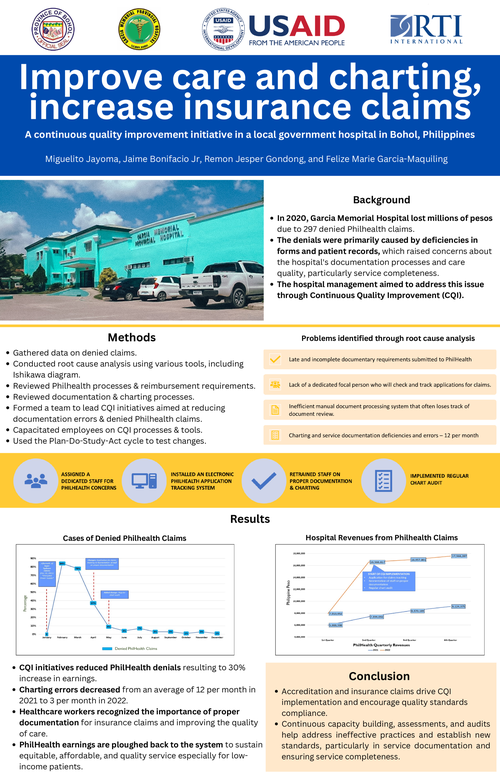
Methods: The GMPH utilized problem analysis and quality improvement toolkits, such as root cause analysis and the plan-do-study-act (PDSA) cycle, to address the high number of denied requests for PhilHealth payment. In 2020, they discovered that deficiencies in charting and documentation, such as incomplete records of assessment and services, were the most common reasons for these denials. These deficiencies also compromised the quality of care and patient safety. Using the PDSA cycle, they tested and later implemented recalibrations in their documentation processes. This included standardizing charting, conducting regular audits of charts, and assigning staff to review compliance with service protocols and hospital records, including those required for PhilHealth claims. They also tracked requests for PhilHealth payment. The hospital's CQI team was responsible for leading the implementation of this quality improvement project and establishing sustainability mechanisms. Additionally, the hospital provided training to nurses and other personnel on effective charting.
Results: The number of denied requests for Philhealth payment decreased significantly after the implementation of the CQI initiative. As a result, hospital earnings increased by nearly 30 percent. Additionally, charting errors decreased from an average of 12 per month in 2021 to 3 per month in 2022. Meanwhile, healthcare workers at the hospital reported that their understanding of the importance of proper documentation, not only for insurance claims but also for ensuring quality care, greatly improved through the capacity building activities led by the hospital management.
Conclusion: Accreditation and insurance claim requirements can prompt the implementation of quality improvement initiatives. Therefore, it is important for insurance agencies to effectively enforce their quality improvement policies in order to encourage healthcare institutions to meet standards and establish mechanisms to enhance their services. Meanwhile, in hospitals, ongoing capacity building activities, along with regular assessments and audits, are effective mechanisms for addressing ineffective and deficient practices and implementing new standards, such as in charting and other service documentation.