708 posters, 8 topics, 16 sessions, 1,190 authors, 600 institutions
ePostersLive by SciGen Technologies S.A. All rights reserved.
ISQua's 39th International Conference 2023
August 27 - 30, 2023 | Seoul, Republic of Korea

ISQUA2023-ABS-2316
STRIKING CANCER THROUGH QUALITY MEASURES: ORIENTATION CANCER CENTERS (COROS), AN ITALIAN EXPERIENCE TO INCREASE HEALTHCARE FOR CANCER.
Poster Presenter
Authors
Affiliations
Part of Topic
Patient Safety & Quality Improvement
Country cancer profile 2023 shows that survival rate for main cancer in Italy is not different from the other EU countries, although less human and economic resources invested in our country
No specifically mention is given in the document about quality indicators that are not widespread for cancer care in Italy. Nevertheless, some indicators are monitored regularly at either the Regional or National level through the National Agency for Regional Health Services, which publishes an annual outcome evaluation of health care services covering both public and private providers.
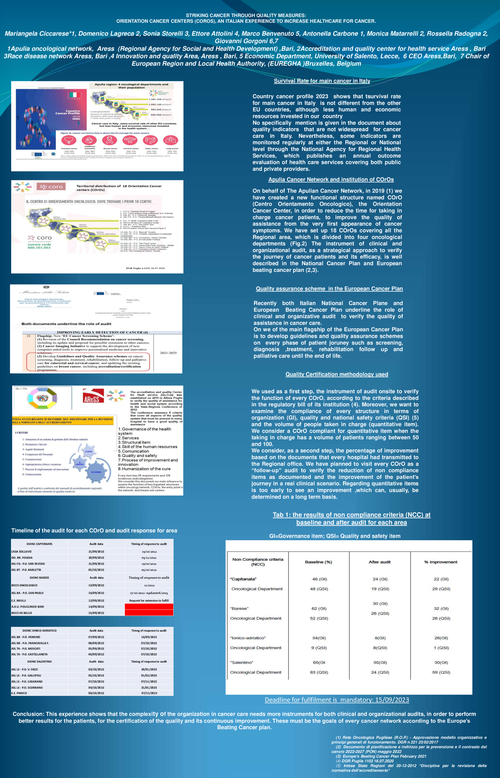
On behalf of The Apulian Cancer Network, in 2019 (1) we have created a new functional structure named COrO (Centro Orientamento Oncologico), the Orientation Cancer Center, in order to reduce the time for taking in charge cancer patients, to improve the quality of assistance from the very first appearance of cancer symptoms. We have set up 18 COrOs covering all the Regional area, which is divided into four oncological departments (Fig.2) The instrument of clinical and organizational audit, as a strategical approach to verify the journey of cancer patients and its efficacy, is well described in the National Cancer Plan and European beating cancer plan (2,3)
Recently both Italian National Cancer Plane and European Beating Cancer Plan underline the role of clinical and organizative audit to verify the quality of assistance in cancer care.
On we of the main flagship of the European Cancer Plan is to develop guidelines and quality assurance schemes on every phase of patient joruney such as screening, diagnosis ,treatment, rehabilitation follow up and palliative care until the end of life.
We used as a first step, the instrument of audit onsite to verify the function of every COrO, according to the criteria described in the regulatory bill of its institution (4). Moreover, we want to examine the compliance of every structure in terms of organization (GI), quality and national safety criteria (QSI) (5) and the volume of people taken in charge (quantitative item). We consider a COrO compliant for quantitative item when the taking in charge has a volume of patients ranging between 50 and 100.
We consider, as a second step, the percentage of improvement based on the documents that every hospital had transmitted to the Regional office. We have planned to visit every COrO as a “follow-up” audit to verify the reduction of non compliance items as documented and the improvement of the patient’s journey in a real clinical scenario. Regarding quantitative items is too early to see an improvement ,which can, usually, be determined on a long term basis.
Tab 1: the results of non compliance criteria (NCC) at baseline and after audit
Conclusion: This experience shows that the complexity of the organization in cancer care needs more instruments for both clinical and organizational audits, in order to perform better results for the patients, for the certification of the quality and its continuous improvement. These must be the goals of every cancer network according to the Europe’s Beating Cancer plan.
