708 posters, 8 topics, 16 sessions, 1,190 authors, 600 institutions
ePostersLive by SciGen Technologies S.A. All rights reserved.
ISQua's 39th International Conference 2023
August 27 - 30, 2023 | Seoul, Republic of Korea

ISQUA2023-ABS-1559
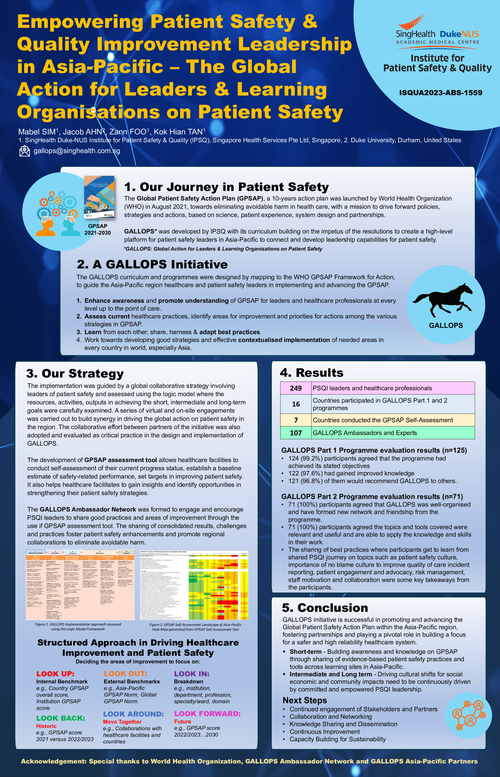
EMPOWERING PATIENT SAFETY & QUALITY IMPROVEMENT LEADERSHIP IN ASIA-PACIFIC - THE GLOBAL ACTION FOR LEADERS & LEARNING ORGANISATIONS ON PATIENT SAFETY
Poster Presenter
Authors
Affiliations
Part of Topic
Patient Safety & Quality Improvement
1. Our Journey in Patient Safety
The Global Patient Safety Action Plan (GPSAP), a 10-years action plan was launched by World Health Organization (WHO) in August 2021, towards eliminating avoidable harm in health care, with a mission to drive forward policies, strategies and actions, based on science, patient experience, system design and partnerships.
GALLOPS* was developed by IPSQ with its curriculum building on the impetus of the resolutions to create a high-level platform for patient safety leaders in Asia-Pacific to connect and develop leadership capabilities for patient safety.
2. A GALLOPS Initiative
The GALLOPS curriculum and programmes were designed by mapping to the WHO GPSAP Framework for Action, to guide the Asia-Pacific region healthcare and patient safety leaders in implementing and advancing the GPSAP.
1.Enhance awareness and promote understanding of GPSAP for leaders and healthcare professionals at every level up to the point of care.
3. Our Strategy
The implementation was guided by a global collaborative strategy involving leaders of patient safety and assessed using the logic model where the resources, activities, outputs in achieving the short, intermediate and long-term goals were carefully examined. A series of virtual and on-site engagements was carried out to build synergy in driving the global action on patient safety in the region. The collaborative effort between partners of the initiative was also adopted and evaluated as critical practice in the design and implementation of GALLOPS.
The development of GPSAP assessment tool allows healthcare facilities to conduct self-assessment of their current progress status, establish a baseline estimate of safety-related performance, set targets in improving patient safety. It also helps healthcare facilitates to gain insights and identify opportunities in strengthening their patient safety strategies.
TThe GALLOPS Ambassador Network was formed to engage and encourage PSQI leaders to share good practices and areas of improvement through the use if GPSAP assessment tool. The sharing of consolidated results, challenges and practices foster patient safety enhancements and promote regional collaborations to eliminate avoidable harm.
4. Results
GALLOPS Part 1 Programme evaluation results (n=125)
GALLOPS Part 2 Programme evaluation results (n=71)
The sharing of best practices where participants get to learn from shared PSQI journey on topics such as patient safety culture, importance of no blame culture to improve quality of care incident reporting, patient engagement and advocacy, risk management, staff motivation and collaboration were some key takeaways from the participants.
5. Conclusion
GALLOPS initiative is successful in promoting and advancing the Global Patient Safety Action Plan within the Asia-Pacific region, fostering partnerships and playing a pivotal role in building a focus for a safer and high reliability healthcare system.
• Short-term - Building awareness and knowledge on GPSAP through sharing of evidence-based patient safety practices and tools across learning sites in Asia-Pacific.
Next Steps