708 posters, 8 topics, 16 sessions, 1,190 authors, 600 institutions
ePostersLive by SciGen Technologies S.A. All rights reserved.
ISQua's 39th International Conference 2023
August 27 - 30, 2023 | Seoul, Republic of Korea

P784
IMPACT OF A TARGETED TEMPERATURE MANAGEMENT QUALITY IMPROVEMENT PROJECT ON SURVIVAL AND NEUROLOGIC OUTCOMES IN CARDIAC ARREST PATIENTS
Poster Presenter
Authors
Affiliations
Part of Topic
Patient Safety & Quality Improvement
IMPACT OF A TARGETED TEMPERATURE MANAGEMENT QUALITY IMPROVEMENT PROJECT ON SURVIVAL AND NEUROLOGIC OUTCOMES IN CARDIAC ARREST PATIENTS
Thung-Hsien Hsu* 1, Wei-Chun Huang1, Kun-Chang Lin1, Wang-Chuan Juang1, Yun-Te Chang1, Meng-Chen Wu1
1Kaohsiung Veterans General Hospital, Kaohsiung, Taiwan
Introduction:Targeted temperature management (TTM) has been recommended for post-resuscitation
care of patients with sudden cardiac arrest (SCA) and the implementation of TTM remains challenging. This study aimed
to evaluate the newly designed Quality Improvement Project (QIP) to improve the quality of TTM and outcomes of
patients with SCA.
Methods: Patients experiencing out-of-hospital cardiac arrest (OHCA) and in-hospital cardiac arrest (IHCA)
with return of spontaneous circulation (ROSC) and who were treated in our hospital between January 2017 and
December 2019 were enrolled retrospectively. QIP was initiated as follows: 1) creating protocols and standard operating
procedures for TTM; 2) documenting shared decision making; 3) creating job training instruction; and 4) starting lean
medical management.
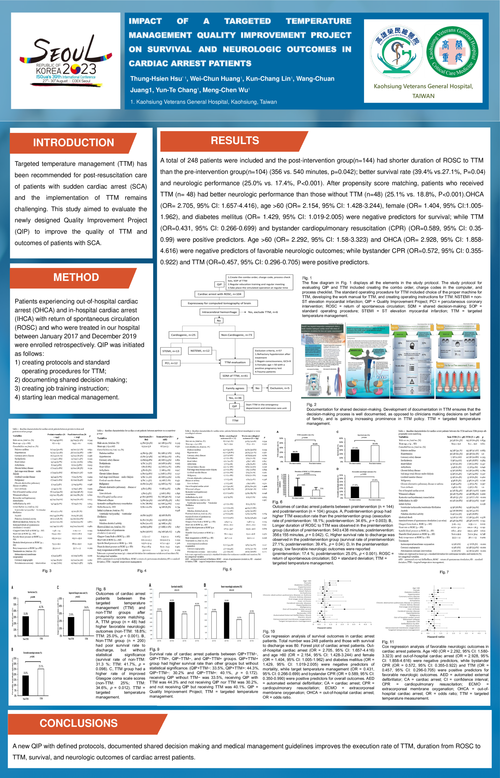
Results: A total of 248 patients were included and the post-intervention group(n=144) had shorter duration of
ROSC to TTM than the pre-intervention group(n=104) (356 vs. 540 minutes, p=0.042); better survival rate (39.4% vs.
27.1%, P=0.04) and neurologic performance (25.0% vs. 17.4%, P<0.001). After propensity score matching, patients who
received TTM (n= 48) had better neurologic performance than those without TTM (n=48) (25.1% vs. 18.8%, P<0.001).
OHCA (OR= 2.705, 95% CI: 1.657-4.416), age >60 (OR= 2.154, 95% CI: 1.428-3.244), female (OR= 1.404, 95% CI:
1.005-1.962), and diabetes mellitus (OR= 1.429, 95% CI: 1.019-2.005) were negative predictors for survival; while TTM
(OR=0.431, 95% CI: 0.266-0.699) and bystander cardiopulmonary resuscitation (CPR) (OR=0.589, 95% CI: 0.35-0.99)
were positive predictors. Age >60 (OR= 2.292, 95% CI: 1.58-3.323) and OHCA (OR= 2.928, 95% CI: 1.858-4.616) were
negative predictors of favorable neurologic outcomes; while bystander CPR (OR=0.572, 95% CI: 0.355-0.922) and TTM
(OR=0.457, 95% CI: 0.296-0.705) were positive predictors.
Conclusions: A new QIP with defined protocols, documented shared decision making and medical
management guidelines improves the execution rate of TTM, duration from ROSC to TTM, survival, and neurologic
outcomes of cardiac arrest patients.