708 posters, 8 topics, 16 sessions, 1,190 authors, 600 institutions
ePostersLive by SciGen Technologies S.A. All rights reserved.
ISQua's 39th International Conference 2023
August 27 - 30, 2023 | Seoul, Republic of Korea

ISQUA2023-ABS-3139
NATURAL LANGUAGE PROCESSING FOR EARLY PREDICTION OF SEVERE SEPSIS IN THE EMERGENCY DEPARTMENT
Poster Presenter
Authors
Affiliations
Part of Topic
NATURAL LANGUAGE PROCESSING FOR EARLY PREDICTION OF SEVERE SEPSIS IN THE EMERGENCY
DEPARTMENT
Po Hsiang Lin* 1, Wei-Chun Huang1, Jer-Guang Hsieh2, Wang-chuan Juang1
1Kaohsiung Veterans General Hospital, 2I-Shou University, Kaohsiung, Taiwan
Introduction: Severe sepsis remain the leading cause of death no matter in the emergency department or
intensive care unit admissions. Early recognition of severe sepsis is the first step for timely management and
resuscitation in the emergency settings.
Nature language processing becomes more and more important as the growth of the electronic health record data and
the improvement of the deep learning method.
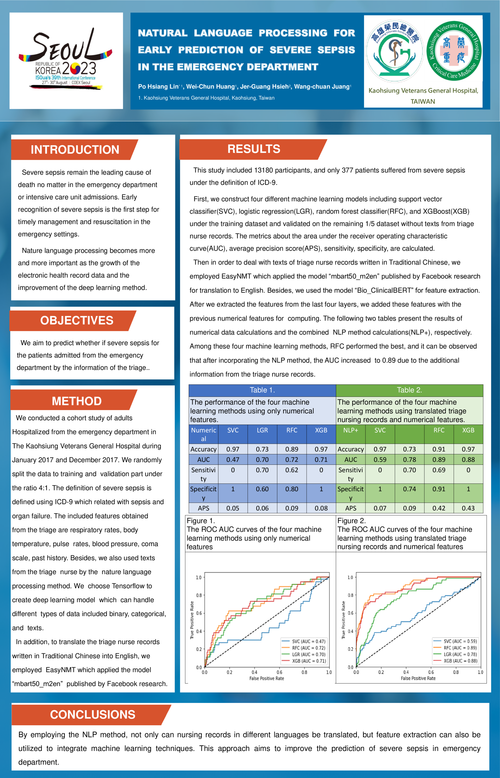
Objectives: We aim to predict whether if severe sepsis for the patients admitted from the emergency department.
Methods: We conducted a cohort study of adults hospitalized from the emergency department in the
Kaohsiung Veterans General Hospital during January 2017 and December 2017. We randomly split the data to training
and validation part under the ratio 4:1. The definition of severe sepsis is defined using ICD-9 which related with sepsis
and organ failure. The included features obtained from the triage are respiratory rates, body temperature, pulse rates,
blood pressure, coma scale, past history, texts from the triage nurse. Besides, we also used the subjective and objective
chart written by the physician by the nature language processing method. We choose Keras and tensorflow to create
deep learning model which can handle different types of data included binary, categorical, and texts.
Results: This study included 13218 participants, and 1777 patients suffered from severe sepsis under the definition of
I C D - 9 .
We construct deep learning model under the training dataset and validated on the remaining 1/5 dataset. We calculated
the area under the receiver operating characteristic curve(AUC), average precision score(APS), sensitivity, specificity,
are calculated. The performance of the baseline accuracy is 86.6%
Conclusion: The nature language processing method can early predict the severe sepsis in the emergency department andmaybe aid the emergent physician for clinical decision.