708 posters, 8 topics, 16 sessions, 1,190 authors, 600 institutions
ePostersLive by SciGen Technologies S.A. All rights reserved.
ISQua's 39th International Conference 2023
August 27 - 30, 2023 | Seoul, Republic of Korea

P320d
Quality improvement capacity building: Using feedback on patient health outcomes to improve orthopedic Physical Therapist practice.
Poster Presenter
Authors
Paige McDonald, Philip van der Wees, Emily Balog, James Irrgang, Hallie Zeleznik, Kenneth Harwood
Affiliations
The George Washington University, The George Washington University; Radboud UMC, The George Washington University; Rutgers University, University of Pittsburgh Medical Centers; Department of Physical Therapy, University of Pittsburgh School of Health and Rehabilitation Sciences, Department of Physical Therapy, University of Pittsburgh School of Health and Rehabilitation Sciences, The George Washington University; Marymount University, College of Health and Education
Part of Topic
Patient Safety & Quality Improvement
Background:
Measuring health outcomes can play an important role in patient-centered healthcare.
When aggregated across patients, outcomes provide data for quality improvement (QI).
However, most physical therapists are not familiar with QI methods based on patient outcomes.
Purpose:
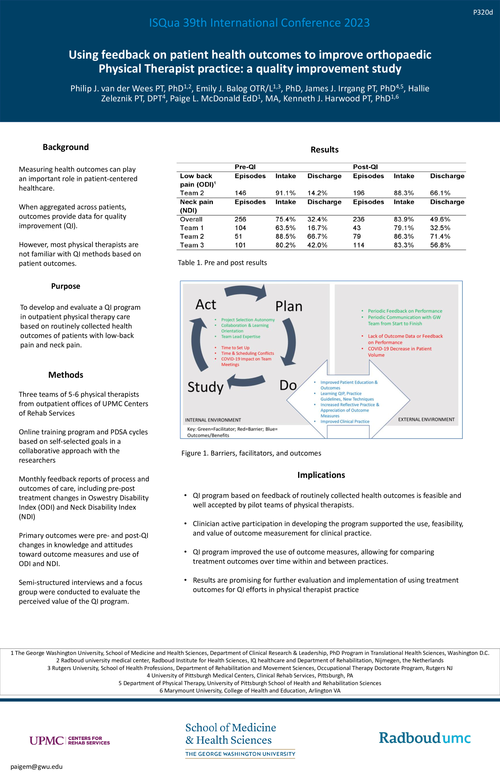
To develop and evaluate a QI program in outpatient physical therapy care based on routinely collected health outcomes of patients with low-back pain and neck pain.
Methods:
Three teams of 5-6 physical therapists from outpatient offices of UPMC Centers of Rehab Services
Online training program and PDSA cycles based on self-selected goals in a collaborative approach with the researchers
Monthly feedback reports of process and outcomes of care, including pre-post treatment changes in Oswestry Disability Index (ODI) and Neck Disability Index (NDI)
Primary outcomes were pre- and post-QI changes in knowledge and attitudes toward outcome measures and use of ODI and NDI.
Semi-structured interviews and a focus group were conducted to evaluate the perceived value of the QI program.
Implications: