708 posters, 8 topics, 16 sessions, 1,190 authors, 600 institutions
ePostersLive by SciGen Technologies S.A. All rights reserved.
ISQua's 39th International Conference 2023
August 27 - 30, 2023 | Seoul, Republic of Korea

P465
SURVEY ON THE CURRENT SITUATION OF SMART PHARMACEUTICAL SERVICES IN TAIWAN IN 2022
Poster Presenter
Part of Topic
Digital Healthcare and Innovation
SURVEY ON THE CURRENT SITUATION OF SMART PHARMACEUTICAL SERVICES IN TAIWAN IN 2022.
Pei-Chia Hsu, Sheng-Hui Hung, Han-Chi Chung, Hui-Wen Kuo, Hsiao-Hsien Rau, Chii-Jeng Lin
Joint Commission of Taiwan, New Taipei City, Taiwan
Introduction: In 2022, ‘Medication safety’ was identified as a major concern in patient safety and selected as the theme for World Patient Safety Day, with the slogan ‘Medication Without Harm.’ All stakeholders are encouraged to take early action to prevent medication-related harm.
Studies have depicted that information technologies can be significantly helpful to reduce medication errors [1]. Medication errors was top-ranked in all patient safety incidents from 2016 to 2020 according to the annual report 2020 of the Taiwan Patient-safety Reporting system. Therefore, the purpose of this study was to investigate the current status of using ‘Healthcare Information Technology’ (HIT) to improve medication safety in a variety of hospitals in Taiwan.
Methods: A survey was conducted using a semi-structured questionnaire involving 462 hospitals, including 22 medical centers and 440 non-medical centers in Taiwan, in 2022. The survey accessed various applications of HIT in pharmaceutical services, encompassing prescribing, dispensing, distribution, health education, and drug management. HIT refers to a broad term that includes interoperability, computation, and artificial intelligence functions.
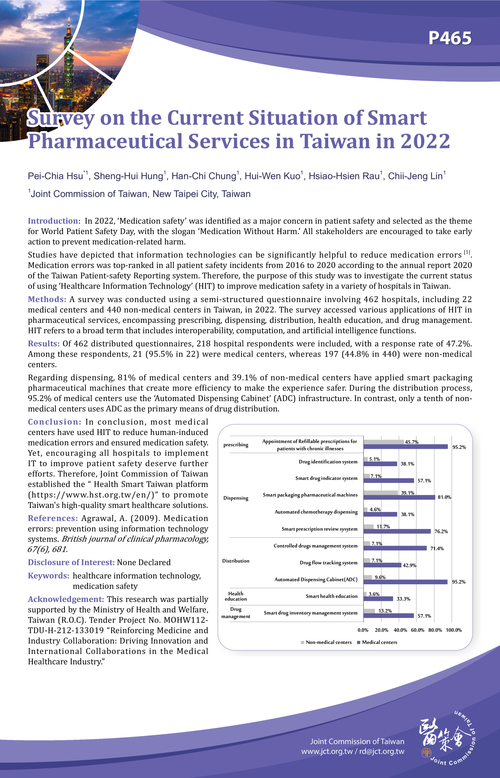
Results: Of 462 distributed questionnaires, 218 hospital respondents were included, with a response rate of 47.2%. Among these respondents, 21 (95.5% in 22) were medical centers, whereas 197 (44.8% in 440) were non-medical centers.
Regarding dispensing, 81% of medical centers and 39.1% of non-medical centers have applied smart packaging pharmaceutical machines that create more efficiency to make the experience safer. During the distribution process, 95.2% of medical centers use the ‘Automated Dispensing Cabinet’ (ADC) infrastructure. In contrast, only a tenth of non-medical centers uses ADC as the primary means of drug distribution.
Conclusion: In conclusion, most medical centers have used HIT to reduce human-induced medication errors and ensured medication safety. Yet, encouraging all hospitals to implement IT to improve patient safety deserve further efforts. Therefore, Joint Commission of Taiwan established the “ Health Smart Taiwan platform (https://www.hst.org.tw/en/)” to promote Taiwan's high-quality smart healthcare solutions.
References: Agrawal, A. (2009). Medication errors: prevention using information technology systems. British journal of clinical pharmacology, 67(6), 681.
Disclosure of Interest: None Declared
Keywords: Healthcare Information Technology, medication safety
Acknowledgement: This research was partially supported by the Ministry of Health and Welfare, Taiwan (R.O.C). Tender Project No. MOHW112-TDU-H-212-133019 “Reinforcing Medicine and Industry Collaboration: Driving Innovation and International Collaborations in the Medical Healthcare Industry.”