708 posters, 8 topics, 16 sessions, 1,190 authors, 600 institutions
ePostersLive by SciGen Technologies S.A. All rights reserved.
ISQua's 39th International Conference 2023
August 27 - 30, 2023 | Seoul, Republic of Korea

ISQUA2023-ABS-1532
DIAGNOSTIC ACCURACY AND PHOTOGRAPHIC QUALITY OF INPATIENT TELEDERMATOLOGY DURING THE COVID-19 PANDEMIC IN SINGAPORE.
Poster Presenter
Part of Topic
Digital Healthcare and Innovation
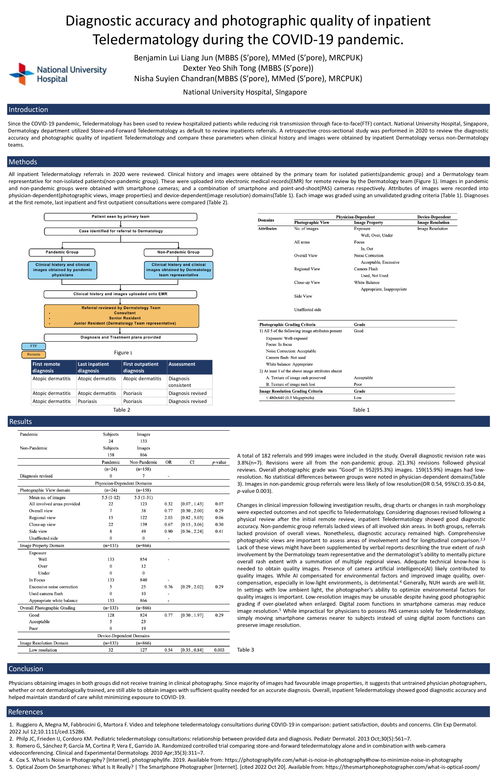
Since the COVID-19 pandemic, Teledermatology has been used to review hospitalized patients while reducing risk transmission through face-to-face(FTF) contact. National University Hospital, Singapore, Dermatology department utilized Store-and-Forward Teledermatology as default to review inpatients referrals. A retrospective cross-sectional study was performed in 2020 to review the diagnostic accuracy and photographic quality of inpatient Teledermatology and compare these parameters when clinical history and images were obtained by inpatient Dermatology versus non-Dermatology teams.
All inpatient Teledermatology referrals in 2020 were reviewed. Clinical history and images were obtained by the primary team for isolated patients(pandemic group) and a Dermatology team representative for non-isolated patients(non-pandemic group). These were uploaded into electronic medical records(EMR) for remote review by the Dermatology team (Figure 1). Images in pandemic and non-pandemic groups were obtained with smartphone cameras; and a combination of smartphone and point-and-shoot(PAS) cameras respectively. Attributes of images were recorded into physician-dependent(photographic views, image properties) and device-dependent(image resolution) domains(Table 1). Each image was graded using an unvalidated grading criteria (Table 1). Diagnoses at the first remote, last inpatient and first outpatient consultations were compared (Table 2).
A total of 182 referrals and 999 images were included in the study. Overall diagnostic revision rate was 3.8%(n=7). Revisions were all from the non-pandemic group. 2(1.3%) revisions followed physical reviews. Overall photographic grade was “Good” in 952(95.3%) images. 159(15.9%) images had low-resolution. No statistical differences between groups were noted in physician-dependent domains(Table 3). Images in non-pandemic group referrals were less likely of low resolution(OR 0.54, 95%CI:0.35-0.84, p-value 0.003).
Changes in clinical impression following investigation results, drug charts or changes in rash morphology were expected outcomes and not specific to Teledermatology. Considering diagnoses revised following a physical review after the initial remote review, inpatient Teledermatology showed good diagnostic accuracy. Non-pandemic group referrals lacked views of all involved skin areas. In both groups, referrals lacked provision of overall views. Nonetheless, diagnostic accuracy remained high. Comprehensive photographic views are important to assess areas of involvement and for longitudinal comparison.2,3 Lack of these views might have been supplemented by verbal reports describing the true extent of rash involvement by the Dermatology team representative and the dermatologist’s ability to mentally picture overall rash extent with a summation of multiple regional views. Adequate technical know-how is needed to obtain quality images. Presence of camera artificial intelligence(AI) likely contributed to quality images. While AI compensated for environmental factors and improved image quality, over-compensation, especially in low-light environments, is detrimental.4 Generally, NUH wards are well-lit. In settings with low ambient light, the photographer’s ability to optimize environmental factors for quality images is important. Low-resolution images may be unusable despite having good photographic grading if over-pixelated when enlarged. Digital zoom functions in smartphone cameras may reduce image resolution.5 While impractical for physicians to possess PAS cameras solely for Teledermatology, simply moving smartphone cameras nearer to subjects instead of using digital zoom functions can preserve image resolution.
Physicians obtaining images in both groups did not receive training in clinical photography. Since majority of images had favourable image properties, it suggests that untrained physician photographers, whether or not dermatologically trained, are still able to obtain images with sufficient quality needed for an accurate diagnosis. Overall, inpatient Teledermatology showed good diagnostic accuracy and helped maintain standard of care whilst minimizing exposure to COVID-19.