708 posters, 8 topics, 16 sessions, 1,190 authors, 600 institutions
ePostersLive by SciGen Technologies S.A. All rights reserved.
ISQua's 39th International Conference 2023
August 27 - 30, 2023 | Seoul, Republic of Korea

ISQUA2023-ABS-1218
EXPLORED THE EFFECT OF TAI CHI EXERCISE IN VR WITH HIGH RISK OF FALLS IN PSYCHIATRIC PATIENTS
Poster Presenter
Authors
Affiliations
Part of Topic
Digital Healthcare and Innovation
EXPLORED THE EFFECT OF TAI CHI EXERCISE IN VR WITH HIGH RISK OF FALLS IN PSYCHIATRIC PATIENTS
Chun-Ti Yu* 1, 2
1Department of Nursing, National Taiwan University Hospital Yunlin Branch, Yunlin, 2Nursing Faculty, National Taiwan University, College of Medicine, Taipei, Taiwan,
Introduction: Falls are one of the common problems in the safety of psychiatric patients. This unit is a day ward for psychiatric patients, with a total of 60 beds. After being admitted to the hospital for fall risk nursing assessment, 90% of patients are at high risk of falling, and among them, 70% of the patients with lower extremity muscle strength assessment were 4 points (except for gravity resistance and partial resistance ) to 5 points (normal) and subjectively complained of weakness, which shows that there is a potential risk of falls. The evidence-based data have shown that performing Tai Chi exercises can improve lower limb muscle strength. The purpose of this study is to explore the psychiatric patients who perform Tai Chi exercises in VR (virtual reality) can improve lower limb muscle strength and indirectly reduce the incidence of falls.
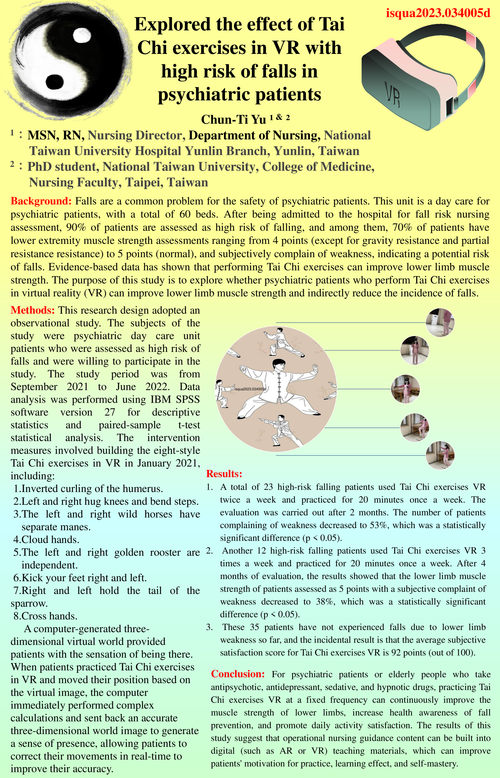
Methods: This research design adopted an observational study. The subjects of the study were psychiatric daycare unit patients who were assessed as high risk of falls and were willing to participate in the study. The study period was from September 2021 to June 2022. Data analysis was performed using IBM SPSS software version 27 for descriptive statistics and paired-sample t-test statistical analysis. The intervention measures were to build the eight-style Tai Chi exercises in VR in January 2021, including 1. Inverted curling of the humerus. 2. Left and right hug knees and bend steps. 3. The left and right wild horses have separate manes. 4. Cloud hands. 5. The left and right golden roosters are independent. 6. Kick your feet right and left. 7. Right and left hold the tail of the sparrow. 8. Cross hands. Using computer analogy to generate a three-dimensional virtual world, providing patients with the feeling as if they were there. When the patient is practicing Tai Chi exercises in VR based on the virtual image to move the position, the computer can immediately perform complex calculations and send back the accurate three-dimensional world image to generate a sense of presence, allowing the patient to correct the movement in time to improve the correctness of the movement.
Results: It can be found that a total of 23 patients with a high risk of falling used Tai Chi exercises in VR twice a week, and once a week they had to practice for 20 minutes. The evaluation was carried out after 2 months. The number of patients complaining of weakness decreased to 53%, a statistically significant difference (p < 0.05). Another 12 patients with a high risk of falls used Tai Chi exercises in VR 3 times a week, and they had to practice for 20 minutes once a week. After 4 months of evaluation, the results showed that the lower limb muscle strength was evaluated as 5 points and the subjective complaint was weak patients can be reduced to 38%, up to a statistically significant difference (p < 0.05). These 35 patients have not experienced falls due to lower limb weakness so far, and the incidental result is that the average subjective satisfaction score for Tai Chi exercises in VR is 92 points (The full score is 100 points).
Conclusion: Psychiatric patients or elderly people who take antipsychotic, antidepressant, sedative, or hypnotic drugs can practice Tai Chi exercises in VR at a fixed frequency and continuously to improve muscle strength of lower limbs, increase the health literacy of fall prevention and promote daily activities satisfaction. The results of this study suggest that operational nursing guidance content can be built into digital (such as AR or VR) teaching materials, which can improve patients' motivation, learning effect, and quality of life.
Keywords: Tai Chi exercises, VR, falls