708 posters, 8 topics, 16 sessions, 1,190 authors, 600 institutions
ePostersLive by SciGen Technologies S.A. All rights reserved.
ISQua's 39th International Conference 2023
August 27 - 30, 2023 | Seoul, Republic of Korea

P300
TRACHEOSTOMY CARE BUNDLE IMPROVES PATIENT OUTCOMES IN KOREA
Poster Presenter
Part of Topic
Patient Safety & Quality Improvement
Tracheostomy Care Bundle Improves Patient Outcomes in Korea
Introduction
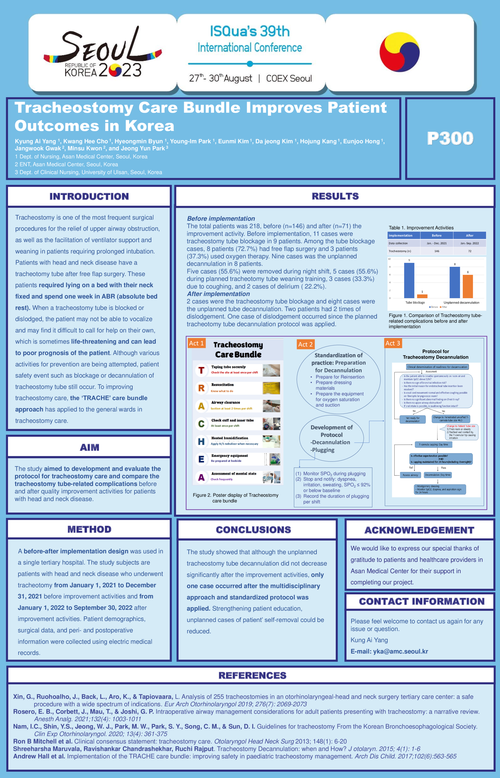
Tracheostomy is one of the most frequent surgical procedures for the relief of upper airway obstruction, as well as the facilitation of ventilator support and weaning in patients requiring prolonged intubation.Patients with head and neck disease have a tracheotomy tube after free flap surgery. These patients required lying on a bed with their neck fixed and spend one week in ABR (absolute bed rest). When a tracheostomy tube is blocked or dislodged, the patient may not be able to vocalize and may find it difficult to call for help on their own, which is sometimes life-threatening and can lead to poor prognosis of the patient. Although various activities for prevention are being attempted, patient safety event such as blockage or decannulation of tracheostomy tube still occur. To improving tracheostomy care, the ‘TRACHE’ care bundle approach has applied to the general wards in tracheostomy care.
Aim
The study aimed to development and evaluate the protocol for tracheostomy care and compare the tracheostomy tube-related complications before and after quality improvement activities for patients with head and neck disease.
Method
A before-after implementation design was used in a single tertiary hospital. The study subjects are patients with head and neck disease who underwent tracheotomy from January 1, 2021 to December 31, 2021 before improvement activities and from January 1, 2022 to September 30, 2022 after improvement activities. Patient demographics, surgical data, and peri- and postoperative information were collected using electric medical records.
Results
Before implementation The total patients was 218, before (n=146) and after (n=71) the improvement activity. Before implementation, 11 cases were tracheostomy tube blockage in 9 patients. Among the tube blockage cases, 8 patients (72.7%) had free flap surgery and 3 patients (37.3%) used oxygen therapy. Nine cases was the unplanned decannulation in 8 patients. Five cases (55.6%) were removed during night shift, 5 cases (55.6%) during planned tracheotomy tube weaning training, 3 cases (33.3%) due to coughing, and 2 cases of delirium ( 22.2%). After implementation 2 cases were the tracheostomy tube blockage and eight cases were the unplanned tube decannulation. Two patients had 2 times of dislodgement. One case of dislodgement occurred since the planned tracheotomy tube decannulation protocol was applied.
Conclusions
The study showed that although the unplanned tracheostomy tube decannulation did not decrease significantly after the improvement activities, only one case occurred after the multidisciplinary approach and standardized protocol was applied. Strengthening patient education, unplanned cases of patient’ self-removal could be reduced.