708 posters, 8 topics, 16 sessions, 1,190 authors, 600 institutions
ePostersLive by SciGen Technologies S.A. All rights reserved.
ISQua's 39th International Conference 2023
August 27 - 30, 2023 | Seoul, Republic of Korea

P540
EVALUATION OF ONLINE PATIENT SAFETY AND QUALITY MASTER OF APPLIED SCIENCE PROGRAM FOR WORKING PROFESSIONALS
Poster Presenter
Authors
Affiliations
Part of Topic
EVALUATION OF ONLINE PATIENT SAFETY AND QUALITY MASTER OF APPLIED SCIENCE PROGRAM FOR WORKING PROFESSIONALS
Julia M. Kim, MD, MPH 1, 2, 3, Matt Austin PhD 1, 2, Paula S. Kent, DrPH, MSN, MBA, RN, 1, 2, Michael Rosen, PhD 1, 2, Cheryl Connors, DNP, RN, NEA-BC, 1, 2, Christina M. Potter, MBA 2, Elizabeth F. Topper, PhD, MEd, MPH 2, Albert W. Wu, MD 1, 3
1 Johns Hopkins Armstrong Institute for Patient Safety and Quality,
2 Johns Hopkins Bloomberg School of Public Health, Baltimore, United States
3 Johns Hopkins University School of Medicine
Introduction: Patient safety and healthcare quality has developed over the past 20 years as a field of research and
practice. There is a need for robust educational programs to build capacity for the quality and safety workforce across
various levels of learners. We evaluated an online patient safety and quality program targeting working professionals with
interest in quality and patient safety.
Methods: The Johns Hopkins Bloomberg School of Public Health Master of Applied Science (MAS) in Patient Safety and
Healthcare Quality is a fully online, part-time degree, completed over at least 2 years for working professionals. In this
descriptive study, a survey was conducted of graduating students from the program in 2019 and 2020, including Likert
scale and qualitative questions ranging from overall satisfaction, program experience, and postgraduate plans.
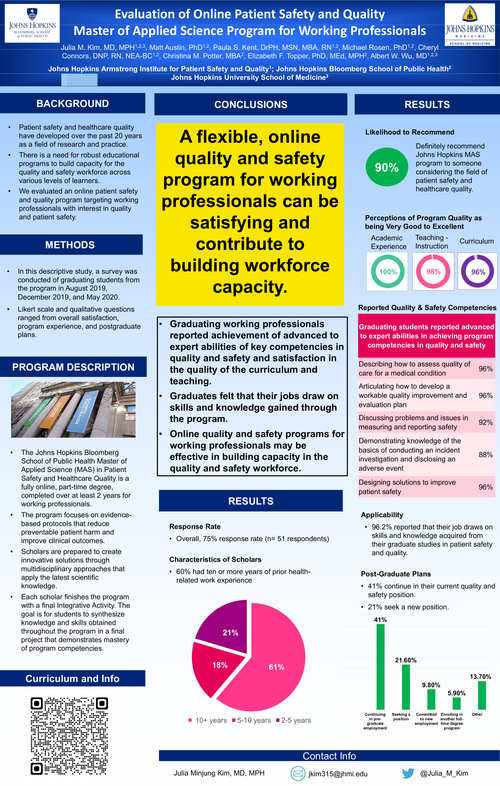
Results: Among 51 respondents (overall 75% response rate), 60% had 10 or more years of prior health-related work
experience, 18% 5-10 years, and 20% 2-5 years. 90% would definitely recommend the Johns Hopkins MAS program to
someone considering the field of patient safety and healthcare quality, and 100% would rate the quality of the academic
experience as very good to excellent. Graduating students reported advanced to expert abilities in achieving program
competencies in quality and safety, such as describing how to assess quality of care for a medical condition (96%),
articulating how to develop a workable quality improvement and evaluation plan (96%), discussing problems and issues
in measuring and reporting safety (92%), demonstrating knowledge of the basics of conducting an incident investigation
and disclosing an adverse event (88%), and designing solutions to improve patient safety (96%). The quality of the
curriculum and quality of teaching and instruction were rated as very good to excellent for 96% and 98% of responses,
respectively. Post-graduate plans included continuing in pre-graduate employment (41%), seeking position (21.6%), committed to new
employment (9.8%), enrolling in another full-time degree program (5.9%), other (13.7%). 100% will be employed full-time
in a health-related position, and 92.3% felt that their position was consistent with their long-term professional goals.
96.2% reported that their job draws on skills and knowledge acquired from their graduate studies in patient safety and
quality.
Conclusion: Graduating working professionals from an online patient safety and healthcare quality master of applied
science program reported achievement of advanced to expert abilities of key competencies in quality and safety and
satisfaction in the quality of the curriculum and teaching. Graduates felt that their jobs draw on skills and knowledge
gained through the program. Online quality and safety programs for working professionals may be effective in building
capacity in the quality and safety workforce.