708 posters, 8 topics, 16 sessions, 1,190 authors, 600 institutions
ePostersLive by SciGen Technologies S.A. All rights reserved.
ISQua's 39th International Conference 2023
August 27 - 30, 2023 | Seoul, Republic of Korea

P846
GLOBAL OVERVIEW OF SUICIDAL BEHAVIOR AND ASSOCIATED RISK FACTORS AMONG PEOPLE LIVING WITH HUMAN IMMUNODEFICIENCY VIRUS: A SCOPING REVIEW
Poster Presenter
Authors
Affiliations
Part of Topic
Global overview of suicidal behavior and associated risk factors among people living with human immunodeficiency virus: A scoping review
Yi-Tseng Tsai 1,2 , Nai-Ying Ko2
1 Department of Nursing, An Nan Hospital, China Medical University, Tainan, Taiwan
2 Department of Nursing, College of Medicine, National Cheng Kung University, Tainan, Taiwan
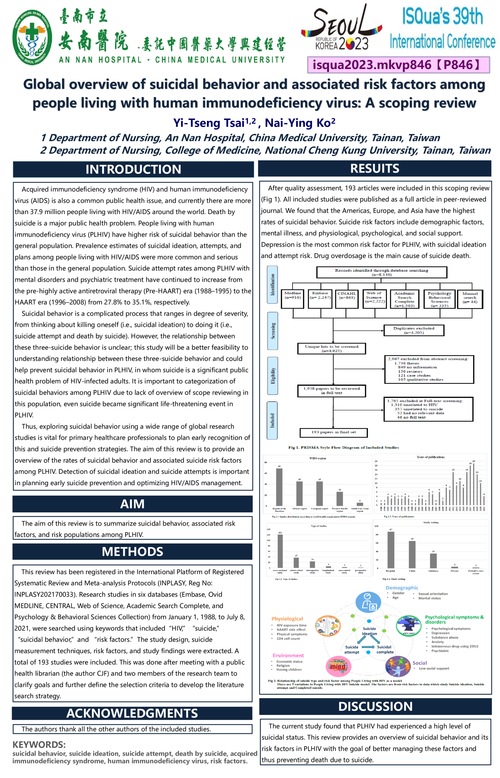
Acquired immunodeficiency syndrome (HIV) and human immunodeficiency virus (AIDS) is also a common public health issue, and currently there are more than 37.9 million people living with HIV/AIDS around the world. Death by suicide is a major public health problem. People living with human immunodeficiency virus (PLHIV) have higher risk of suicidal behavior than the general population. Prevalence estimates of suicidal ideation, attempts, and plans among people living with HIV/AIDS were more common and serious than those in the general population. Suicide attempt rates among PLHIV with mental disorders and psychiatric treatment have continued to increase from the pre-highly active antiretroviral therapy (Pre-HAART) era (1988–1995) to the HAART era (1996–2008) from 27.8% to 35.1%, respectively. Suicidal behavior is a complicated process that ranges in degree of severity, from thinking about killing oneself (i.e., suicidal ideation) to doing it (i.e., suicide attempt and death by suicide). However, the relationship between these three-suicide behavior is unclear; this study will be a better feasibility to understanding relationship between these three-suicide behavior and could help prevent suicidal behavior in PLHIV, in whom suicide is a significant public health problem of HIV-infected adults. It is important to categorization of suicidal behaviors among PLHIV due to lack of overview of scope reviewing in this population, even suicide became significant life-threatening event in PLHIV. Thus, exploring suicidal behavior using a wide range of global research studies is vital for primary healthcare professionals to plan early recognition of this and suicide prevention strategies. The aim of this review is to provide an overview of the rates of suicidal behavior and associated suicide risk factors among PLHIV. Detection of suicidal ideation and suicide attempts is important in planning early suicide prevention and optimizing HIV/AIDS management.