708 posters, 8 topics, 16 sessions, 1,190 authors, 600 institutions
ePostersLive by SciGen Technologies S.A. All rights reserved.
ISQua's 39th International Conference 2023
August 27 - 30, 2023 | Seoul, Republic of Korea

P882
A RETROSPECTIVE ANALYSIS OF STRENGTHS OF RECOMMENDATIONS FROM ROOT CAUSE ANALYSIS AND THE SUBSEQUENT PERCEIVED IMPACT AND SUSTAINABILITY
Poster Presenter
Authors
Rexford DEL ROSARIO, Mahdhir Bin Ahmat TUGIMAN, Siew Lan ANG, Ghee Hian LIM
Affiliations
Part of Topic
Patient Safety & Quality Improvement
A retrospective analysis of the strengths of recommendations from root cause analysis and the subsequent perceived impact and sustainability
Introduction: Traditionally, following Serious Reportable Events (SREs), Root Cause Analyses (RCA) are performed to investigate and pinpoint the contributing factors that led to the adverse incident. Thereafter, recommendations are proposed and implemented to prevent the recurrence of similar incidents. Many methodologies detailing the workflow from the onset of a SRE to the implementation of control measures already exist. However, SREs of the same nature continue to repeat itself. This raises the question, are RCAs useful in effecting long-term solutions to prevent the incidence of SREs?
Objective: This study aimed to explore the relationship between the strength of RCA recommendations and the subsequent perceived impact and sustainability.
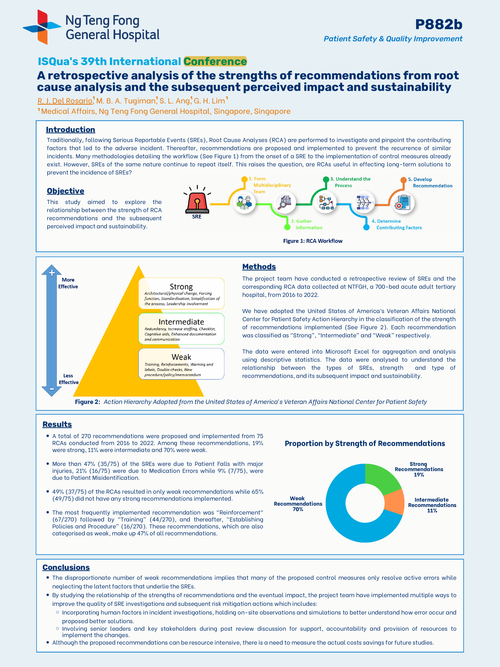
Methods: The project team have conducted a retrospective review of SREs and the corresponding RCA data collected at NTFGH, a 700-bed acute adult tertiary hospital, from 2016 to 2022. We have adopted the United States of America’s Veteran Affairs National Center for Patient Safety Action Hierarchy in the classification of the strength of recommendations implemented. Each recommendation was classified as “Strong”, “Intermediate” and “Weak” respectively. The data were entered into Microsoft Excel for aggregation and analysis using descriptive statistics. The data were analysed to understand the relationship between the types of SREs, strength and type of recommendations, and its subsequent impact and sustainability.
Results: A total of 270 recommendations were proposed and implemented from 75 RCAs conducted from 2016 to 2022. Among these recommendations, 19% were strong, 11% were intermediate and 70% were weak. More than 47% (35/75) of the SREs were due to Patient Falls with major injuries, 21% (16/75) were due to Medication Errors while 9% (7/75), were due to Patient Misidentification. 49% (37/75) of the RCAs resulted in only weak recommendations while 65% (49/75) did not have any strong recommendations implemented. The most frequently implemented recommendation was "Reinforcement" (67/270) followed by “Training” (44/270), and thereafter, “Establishing Policies and Procedure” (16/270). These recommendations, which are also categorised as weak, make up 47% of all recommendations.
Conclusions: The disproportionate number of weak recommendations implies that many of the proposed control measures only resolve active errors while neglecting the latent factors that underlie the SREs. By studying the relationship of the strengths of recommendations and the eventual impact, the project team have implemented multiple ways to improve the quality of SRE investigations and subsequent risk mitigation actions which includes: Incorporating human factors in incident investigations, holding on-site observations and simulations to better understand how error occur and proposed better solutions. Involving senior leaders and key stakeholders during post review discussion for support, accountability and provision of resources to implement the changes. Although the proposed recommendations can be resource intensive, there is a need to measure the actual costs savings for future studies.