708 posters, 8 topics, 16 sessions, 1,190 authors, 600 institutions
ePostersLive by SciGen Technologies S.A. All rights reserved.
ISQua's 39th International Conference 2023
August 27 - 30, 2023 | Seoul, Republic of Korea

P882h
NIPT: THE BOON TO LOW-RISK PREGNANCIES SHIELDING FROM INVASIVE METHODS
Poster Presenter
Part of Topic
Patient Safety & Quality Improvement
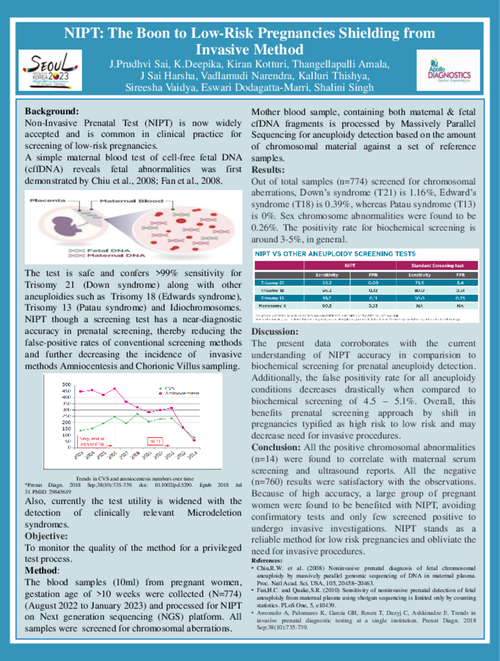
NIPT: The Boon to Low-Risk Pregnancies Shielding from Invasive Method
Non-Invasive Prenatal Test (NIPT) is now widely accepted and is common in clinical practice for screening of low-risk pregnancies.
A simple maternal blood test of cell-free fetal DNA (cffDNA) reveals fetal abnormalities was first demonstrated by Chiu et al., 2008; Fan et al., 2008.
The test is safe and confers >99% sensitivity for Trisomy 21 (Down syndrome) along with other aneuploidies such as Trisomy 18 (Edwards syndrome), Trisomy 13 (Patau syndrome) and Idiochromosomes. NIPT though a screening test has a near-diagnostic accuracy in prenatal screening, thereby reducing the false-positive rates of conventional screening methods and further decreasing the incidence of invasive methods Amniocentesis and Chorionic Villus sampling.
Also, currently the test utility is widened with the detection of clinically relevant Microdeletion syndromes.
Objective:
To monitor the quality of the method for a privileged test process.
Method:
The blood samples (10ml) from pregnant women, gestation age of >10 weeks were collected (N=774) (August 2022 to January 2023) and processed for NIPT on Next generation sequencing (NGS) platform. All samples were screened for chromosomal aberrations.
Mother blood sample, containing both maternal & fetal cfDNA fragments is processed by Massively Parallel Sequencing for aneuploidy detection based on the amount of chromosomal material against a set of reference samples.
Results:
Out of total samples (n=774) screened for chromosomal aberrations, Down’s syndrome (T21) is 1.16%, Edward’s syndrome (T18) is 0.39%, whereas Patau syndrome (T13) is 0%. Sex chromosome abnormalities were found to be 0.26%. The positivity rate for biochemical screening is around 3-5%, in general.
Discussion:
The present data corroborates with the current understanding of NIPT accuracy in comparision to biochemical screening for prenatal aneuploidy detection. Additionally, the false positivity rate for all aneuploidy conditions decreases drastically when compared to biochemical screening of 4.5 – 5.1%. Overall, this benefits prenatal screening approach by shift in pregnancies typified as high risk to low risk and may decrease need for invasive procedures.
Conclusion: All the positive chromosomal abnormalities (n=14) were found to correlate with maternal serum screening and ultrasound reports. All the negative (n=760) results were satisfactory with the observations. Because of high accuracy, a large group of pregnant women were found to be benefited with NIPT, avoiding confirmatory tests and only few screened positive to undergo invasive investigations. NIPT stands as a reliable method for low risk pregnancies and obliviate the need for invasive procedures.