708 posters, 8 topics, 16 sessions, 1,190 authors, 600 institutions
ePostersLive by SciGen Technologies S.A. All rights reserved.
ISQua's 39th International Conference 2023
August 27 - 30, 2023 | Seoul, Republic of Korea

ISQUA2023-ABS-2076
EFFECTIVENESS OF FIDELITY-ENHANCED RESUSCITATION TRAINING USING SIMULATION DEBRIEFING TECHNIQUE
Poster Presenter
Part of Topic
Patient Safety & Quality Improvement
EFFECTIVENESS OF FIDELITY-ENHANCED RESUSCITATION TRAINING USING SIMULATION DEBRIEFING TECHNIQUE
Introduction
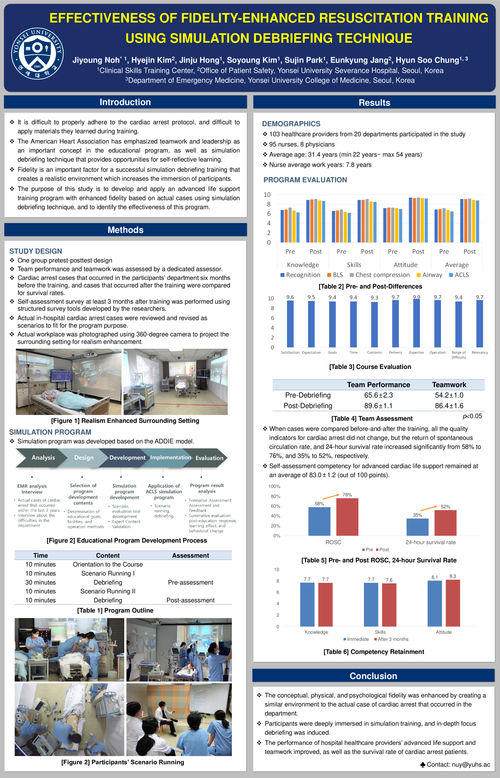
It is difficult to properly adhere to the cardiac arrest protocol, and difficult to apply materials they learned during training.
The American Heart Association has emphasized teamwork and leadership as an important concept in the educational program, as well as simulation debriefing technique that provides opportunities for self-reflective learning.
Fidelity is an important factor for a successful simulation debriefing training that creates a realistic environment which increases the immersion of participants.
The purpose of this study is to develop and apply an advanced life support training program with enhanced fidelity based on actual cases using simulation debriefing technique, and to identify the effectiveness of this program.
Methods
STUDY DESIGN
One group pretest-posttest design
Team performance and teamwork was assessed by a dedicated assessor.
Cardiac arrest cases that occurred in the participants' department six months before the training, and cases that occurred after the training were compared for survival rates.
Self-assessment survey at least 3 months after training was performed using structured survey tools developed by the researchers.
Actual in-hospital cardiac arrest cases were reviewed and revised as scenarios to fit for the program purpose.
Actual workplace was photographed using 360-degree camera to project the surrounding setting for realism enhancement.
SIMULATION PROGRAM
Simulation program was developed based on the ADDIE model.
Results
DEMOGRAPHICS
103 healthcare providers from 20 departments participated in the study
95 nurses, 8 physicians
Average age: 31.4 years (min 22 years~ max 54 years)
Nurse average work years: 7.8 years
PROGRAM EVALUATION
When cases were compared before-and-after the training, all the quality indicators for cardiac arrest did not change, but the return of spontaneous circulation rate, and 24-hour survival rate increased significantly from 58% to 76%, and 35% to 52%, respectively.
Self-assessment competency for advanced cardiac life support remained at an average of 83.0±1.2 (out of 100 points).
Conclusion
The conceptual, physical, and psychological fidelity was enhanced by creating a similar environment to the actual case of cardiac arrest that occurred in the department.
Participants were deeply immersed in simulation training, and in-depth focus debriefing was induced.
The performance of hospital healthcare providers’ advanced life support and teamwork improved, as well as the survival rate of cardiac arrest patients.