708 posters, 8 topics, 16 sessions, 1,190 authors, 600 institutions
ePostersLive by SciGen Technologies S.A. All rights reserved.
ISQua's 39th International Conference 2023
August 27 - 30, 2023 | Seoul, Republic of Korea

P882d
A SUSTAINABLE APPROACH TO REDUCE REPEATED MEDICATION ERROR IN A MULTISPECIALTY TERTIARY CARE HOSPITAL IN EASTERN INDIA.
Poster Presenter
Authors
Affiliations
Part of Topic
Patient Safety & Quality Improvement
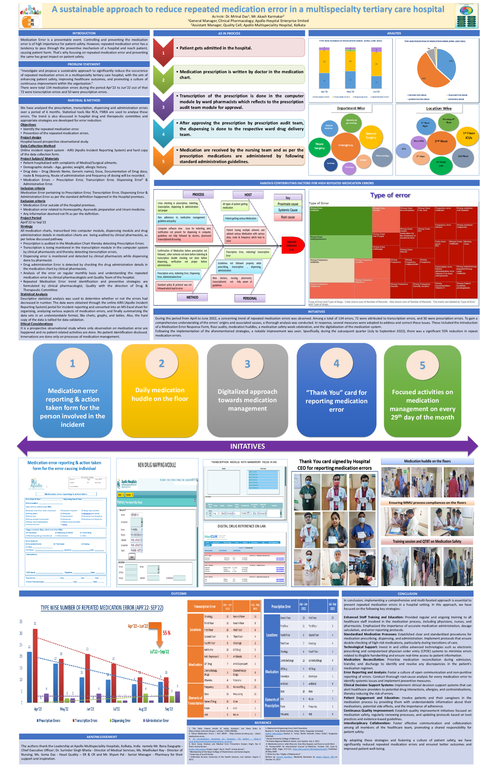
A sustainable approach to reduce repeated medication error in a multispecialty tertiary care hospital
Medication Error is a preventable event. Controlling and preventing the medication error is of high importance for patient safety. However, repeated medication error has a tendency to pass through the preventive mechanism of a hospital and reach patient, causing patient harm. That's why focusing on repeated medication error and preventing the same has great impact on patient safety.
We have analyzed the prescription, transcription, dispensing and administration errors over a period of 6 months. Statistical tools like RCA, FMEA are used to analyse these errors. The trend is also discussed in hospital drug and therapeutic committee and appropriate strategies are developed for error reduction.
Objectives
Project design
Hospital based prospective observational study.
Data Collection Method
Online incident report system - AIRS (Apollo Incident Reporting System) and hard copy of the data collection form.
Project Subject/ Materials
Inclusion criteria
Medication Error pertaining to Prescription Error, Transcription Error, Dispensing Error & Administration Error as per the standard definition happened in the Hospital premises.
Exclusion criteria
Project Period
April’22 to Sep’22
Strategy
All medication charts, transcribed into computer module, dispensing module and drug administration details in medication charts are being audited by clinical pharmacists, as per below discussed pathway
Statistical Analysis
Descriptive statistical analysis was used to determine whether or not the errors had decreased in number. The data were obtained through the online AIRS (Apollo Incident Reporting System) portal for incident reporting and converted into an MS Excel sheet for organizing, analyzing various aspects of medication errors, and finally summarizing the data sets in an understandable format, like charts, graphs, and tables. Also, the hard copy of the data is tallied for data validation.
Ethical Considerations
It is a prospective observational study where only observation on medication error are happened and no patient related activities are done. No patient identification disclosed. Innervations are done only on processes of medication management.
In conclusion, implementing a comprehensive and multi-faceted approach is essential to prevent repeated medication errors in a hospital setting. In this approach, we have focused on the following key strategies:
Enhanced Staff Training and Education: Provided regular and ongoing training to all healthcare staff involved in the medication process, including physicians, nurses, and pharmacists. Emphasized the importance of accurate medication administration, dosage calculation, and error reporting protocols.
Standardized Medication Processes: Established clear and standardized procedures for medication prescribing, dispensing, and administration. Implement protocols that ensure double-checking of high-risk medications, particularly during transitions of care.
Technological Support: Invest in and utilize advanced technologies such as electronic prescribing and computerized physician order entry (CPOE) systems to minimize errors related to illegible handwriting and ensure real-time access to patient information.
Medication Reconciliation: Prioritize medication reconciliation during admission, transfer, and discharge to identify and resolve any discrepancies in the patient's medication regimen.
Error Reporting and Analysis: Foster a culture of open communication and non-punitive reporting of errors. Conduct thorough root-cause analysis for every medication error to identify systemic issues and implement preventive measures.
Clinical Decision Support Systems: Implement clinical decision support systems that can alert healthcare providers to potential drug interactions, allergies, and contraindications, thereby reducing the risk of errors.
Patient Engagement and Education: Involve patients and their caregivers in the medication process by providing them with understandable information about their medications, potential side effects, and the importance of adherence.
Continuous Quality Improvement: Establish quality improvement initiatives focused on medication safety, regularly reviewing processes, and updating protocols based on best practices and evidence-based guidelines.
Interdisciplinary Collaboration: Foster effective communication and collaboration among all members of the healthcare team, promoting a shared responsibility for patient safety.
By adopting these strategies and fostering a culture of patient safety, we have significantly reduced repeated medication errors and ensured better outcomes and improved patient well-being.