708 posters, 8 topics, 16 sessions, 1,190 authors, 600 institutions
ePostersLive by SciGen Technologies S.A. All rights reserved.
ISQua's 39th International Conference 2023
August 27 - 30, 2023 | Seoul, Republic of Korea

P871
EFFECTIVENESS OF SWALLOWING TRAINING TO IMPROVE DYSPHAGIA IN THE ELDERLY
Poster Presenter
Authors
Affiliations
Part of Topic
Patient Safety & Quality Improvement
Whether swallowing training can effectively improve dysphagia in the elderly
Research background
Among the elderly, dysphagia is the most common and life-threatening problem, it will cause aspiration pneumonia, malnutrition or dehydration, etc. The incidence of dysphagia of elders over 50 years old is as high as 22%.Therefore, this research explores if the swallowing training will improve dysphagia of the elderly.
Research method
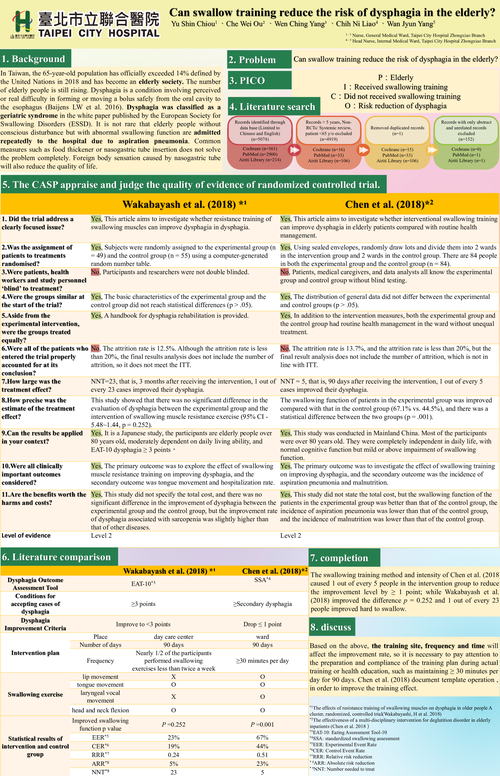
The Cochrane, PubMed, Huayi and other databases were used to search keywords, and PICO was searched by Ebringer logic combination. The search for literature was limited to Systematic Review (SR), Randomized controlled trials (RCT), and Chinese and English literature and were limited to the publication within 5 years. The studies of Chen Qian et al. (2018) and Wakabayash et al. (2018) could not reach the level of blinded research. Their result did not include the loss and the result analysis. However other evaluations were matched. According to the 2011 Oxford evidence scale, both articles were evaluated as Level 2.
Research result
Chen Qian et al. (2018) showed that the swallowing function of patients in the intervention group was improved with a statistical difference (p = .001). The EER of dysphagia was improved by 67%, which was statistically significant compared with the CER of 44% in the control group (p = .001). = .002). The RRR is 0.51, ARR is 23%, NNT = 5. Using the standard evaluation of swallowing function, the score of the intervention group was lower than that of the control group, which was statistically significant (p = .004); Wakabayash et al. (2018) showed that there was no significant difference in the evaluation of dysphagia in the experimental group (p = 0.252), which improved dysphagia The EER was 23%, which was not statistically significant compared with the control group CER 19% (p = 0.598), RRR was 0.24, ARR was 5%, NNT=23. It can be seen from the above that interventional swallowing training can improve dysphagia in the elderly.
Conclusion
Gathering the best current evidence, the research of Chen Qian et al. (2018) showed that intervention in swallowing rehabilitation exercises, 30 minutes a day, can improve dysphagia for 1 in every 5 people; the research results of Wakabayash et al. (2018) was that tongue resistance and head flexion exercise was carried out for 10 seconds each, and 10 times constituted a group. These two groups of exercises were performed 3 times a day for 3 months. One person in every 23 people could improve dysphagia. The comprehensive results showed that swallowing training was performed for 30 minutes a day. Sustaining for 3 months can improve the dysphagia of the elderly, and can also reduce the incidence of aspiration pneumonia and malnutrition. Therefore, swallowing training can be recommended for elderly patients to improve dysphagia.