708 posters, 8 topics, 16 sessions, 1,190 authors, 600 institutions
ePostersLive by SciGen Technologies S.A. All rights reserved.
ISQua's 39th International Conference 2023
August 27 - 30, 2023 | Seoul, Republic of Korea

P866
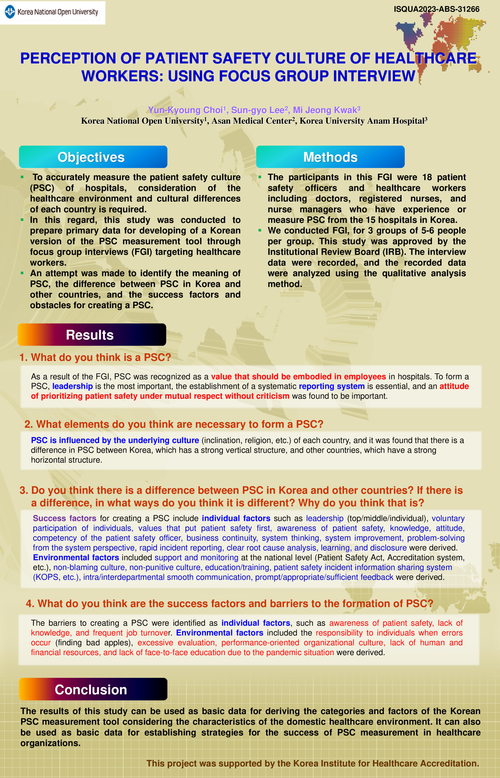
PERCEPTION OF PATIENT SAFETY CULTURE OF HEALTHCARE WORKERS: USING FOCUS GROUP INTERVIEW
Poster Presenter
Authors
Affiliations
Part of Topic
Patient Safety & Quality Improvement
PERCEPTION OF PATIENT SAFETY CULTURE OF HEALTHCARE WORKERS: USING FOCUS GROUP INTERVIEW
Yun-Kyoung Choi1, Sun-gyo Lee2, Mi Jeong Kwak3
Korea National Open University1, Asan Medical Center2, Korea University Anam Hospital3
Objectives
Methods
Results
1. What do you think is a PSC?
As a result of the FGI, PSC was recognized as a value that should be embodied in employees in hospitals. To form a PSC, leadership is the most important, the establishment of a systematic reporting system is essential, and an attitude of prioritizing patient safety under mutual respect without criticism was found to be important.
2. What elements do you think are necessary to form a PSC?
PSC is influenced by the underlying culture (inclination, religion, etc.) of each country, and it was found that there is a difference in PSC between Korea, which has a strong vertical structure, and other countries, which have a strong horizontal structure.
3. Do you think there is a difference between PSC in Korea and other countries? If there is a difference, in what ways do you think it is different? Why do you think that is?
Success factors for creating a PSC include individual factors such as leadership (top/middle/individual), voluntary participation of individuals, values that put patient safety first, awareness of patient safety, knowledge, attitude, competency of the patient safety officer, business continuity, system thinking, system improvement, problem-solving from the system perspective, rapid incident reporting, clear root cause analysis, learning, and disclosure were derived.
Environmental factors included support and monitoring at the national level (Patient Safety Act, Accreditation system, etc.), non-blaming culture, non-punitive culture, education/training, patient safety incident information sharing system (KOPS, etc.), intra/interdepartmental smooth communication, prompt/appropriate/sufficient feedback were derived.
4. What do you think are the success factors and barriers to the formation of PSC?
The barriers to creating a PSC were identified as individual factors, such as awareness of patient safety, lack of knowledge, and frequent job turnover. Environmental factors included the responsibility to individuals when errors occur (finding bad apples), excessive evaluation, performance-oriented organizational culture, lack of human and financial resources, and lack of face-to-face education due to the pandemic situation were derived.
Conclusion
The results of this study can be used as basic data for deriving the categories and factors of the Korean PSC measurement tool considering the characteristics of the domestic healthcare environment. It can also be used as basic data for establishing strategies for the success of PSC measurement in healthcare organizations.
This project was supported by the Korea Institute for Healthcare Accreditation