708 posters, 8 topics, 16 sessions, 1,190 authors, 600 institutions
ePostersLive by SciGen Technologies S.A. All rights reserved.
ISQua's 39th International Conference 2023
August 27 - 30, 2023 | Seoul, Republic of Korea

P858
RESULTS OF A QUESTIONNAIRE SURVEY ON THE TIME REQUIRED TO PERFORM CARDIOPULMONARY RESUSCITATION(CPR) ON PATIENTS WITH CARDIOPULMONARY ARREST
Poster Presenter
Authors
Affiliations
Part of Topic
Patient Safety & Quality Improvement
Results of a Questionnaire Survey on the Time Required to Perform Cardiopulmonary Resuscitation on Patients with Cardiopulmonary Arrest
Introduction:
・There are no clear guidelines on how long CPR (cardiopulmonary resuscitation) should be given to patients who are transported in cardiopulmonary arrest.
・In Europe and the United States, universal TOR (termination of resuscitation criteria) standards have been established, but in Japan, it is still largely up to the discretion of the medical staff.
・This study aimed to understand what kind of on-site decisions are made regarding resuscitation time in cases of cardiopulmonary arrest.
Methods:
・A questionnaire survey was administered to 15 physicians engaged in emergency care at two major medical facilities in Hiroshima, Japan.
・The questionnaire was a self-administered, unmarked, web-based survey.
・Respondents answered the following questions: background of respondents, whether the facility has a policy on resuscitation, resuscitation time according to the patient background.
Results:
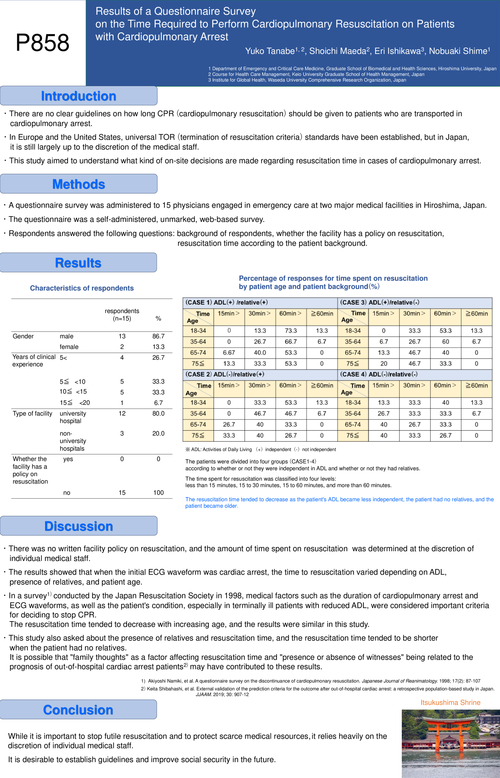
The resuscitation time tended to decrease as the patient's ADL became less independent, the patient had no relatives, and the patient became older.
Discussion:
・There was no written facility policy on resuscitation, and the amount of time spent on resuscitation was determined at the discretion of individual medical staff.
・The results showed that when the initial ECG waveform was cardiac arrest, the time to resuscitation varied depending on ADL, presence of relatives, and patient age.
・In a survey conducted by the Japan Resuscitation Society in 1998, medical factors such as the duration of cardiopulmonary arrest and ECG waveforms, as well as the patient's condition, especially in terminally ill patients with reduced ADL, were considered important criteria for deciding to stop CPR. The resuscitation time tended to decrease with increasing age, and the results were similar in this study.
・This study also asked about the presence of relatives and resuscitation time, and the resuscitation time tended to be shorter when the patient had no relatives. It is possible that "family thoughts" as a factor affecting resuscitation time and "presence or absence of witnesses" being related to the prognosis of out-of-hospital cardiac arrest patients2) may have contributed to these results.
Conclusion:
While it is important to stop futile resuscitation and to protect scarce medical resources, it relies heavily on the discretion of individual medical staff.
It is desirable to establish guidelines and improve social security in the future.