708 posters, 8 topics, 16 sessions, 1,190 authors, 600 institutions
ePostersLive by SciGen Technologies S.A. All rights reserved.
ISQua's 39th International Conference 2023
August 27 - 30, 2023 | Seoul, Republic of Korea

P856
ASSESSMENT OF QUALITY IMPROVEMENT IN ASTHMA PATIENT CARE IN KOREAN PRIMARY CLINICS
Poster Presenter
Authors
Affiliations
Part of Topic
Patient Safety & Quality Improvement
<INTRODUCTION>
- Asthma is a chronic disease that can prevent worsening of the disease and hospital admission through effective treatment.
- The rate of asthma hospital admissions per 100,000 people in Korea is consistently higher (65.0 in 2019) than the OECD average (37.5 in 2019). Accordingly, the Korean Health Insurance Review and Assessment Service(HIRA) introduced the quality assessment(QA) program for asthma care in 2013, leading to improvement in the quality of asthma management.
<AIM>
- Since the majority of asthma patients in Korea are treated in primary clinics, improving the quality of clinics is important.
- The purpose of this study is to assess the level of quality improvement in asthma care provided by clinics over a period of 10 years.
<METHOD>
1) Data Source
- The national health insurance data of HIRA from 2013 to 2021 were targeted.
- Data of asthma outpatients aged 15 years or older, which is the standard age for asthma statistics in OECD, were targeted.
2) Indicators of Assessment
- The QA indicators of asthma care consisted of 7 indicators.
- In order to compare the results of clinics, the overall score was calculated by arithmetic average of the scores of each indicator.
<RESULTS>
1) Overall Score
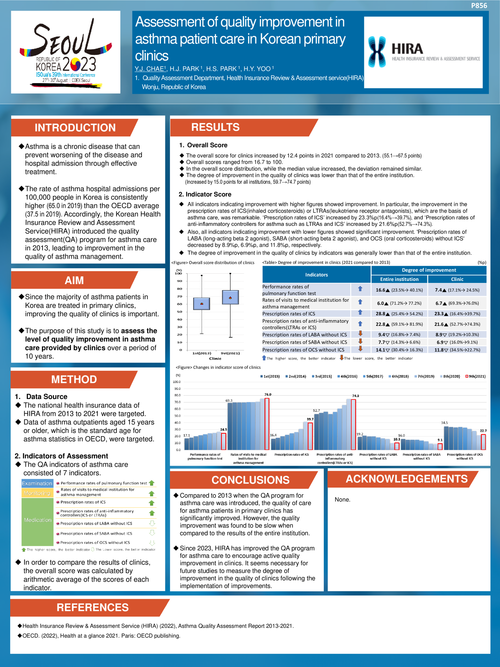
- The overall score for clinics increased by 12.4 points in 2021 compared to 2013. (55.1→67.5 points)
- Overall scores ranged from 16.7 to 100.
- In the overall score distribution, while the median value increased, the deviation remained similar.
- The degree of improvement in the quality of clinics was lower than that of the entire institution.
(Increased by 15.0 points for all institutions, 59.7→74.7 points)
2) Indicator Score
- All indicators indicating improvement with higher figures showed improvement. In particular, the improvement in the prescription rates of ICS(inhaled corticosteroids) or LTRAs(leukotriene receptor antagonists), which are the basis of asthma care, was remarkable. ‘Prescription rates of ICS’ increased by 23.3%p(16.4%→39.7%), and ‘Prescription rates of anti-inflammatory controllers for asthma such as LTRAs and ICS’ increased by 21.6%p(52.7%→74.3%).
- Also, all indicators indicating improvement with lower figures showed significant improvement. 'Prescription rates of
LABA (long-acting beta 2 agonist), SABA (short-acting beta 2 agonist), and OCS (oral corticosteroids) without ICS' decreased by 8.9%p, 6.9%p, and 11.8%p, respectively.
- The degree of improvement in the quality of clinics by indicators was generally lower than that of the entire institution.
<CONCLUSIONS>
- Compared to 2013 when the QA program for asthma care was introduced, the quality of care for asthma patients in primary clinics has significantly improved. However, the quality improvement was found to be slow when compared to the results of the entire institution.
- Since 2023, HIRA has improved the QA program for asthma care to encourage active quality improvement in clinics. It seems necessary for future studies to measure the degree of improvement in the quality of clinics following the implementation of improvements.
<REFERENCES>
- Health Insurance Review & Assessment Service (HIRA) (2022), Asthma Quality Assessment Report 2013-2021.
- OECD. (2022), Health at a glance 2021. Paris: OECD publishing.