708 posters, 8 topics, 16 sessions, 1,190 authors, 600 institutions
ePostersLive by SciGen Technologies S.A. All rights reserved.
ISQua's 39th International Conference 2023
August 27 - 30, 2023 | Seoul, Republic of Korea

P849
NUTRITIONAL MANAGEMENT IMPROVEMENT THROUGH MEAL DEVELOPMENT AFTER SURGERY
Poster Presenter
Authors
Affiliations
Part of Topic
Patient Safety & Quality Improvement
NUTRITIONAL MANAGEMENT IMPROVEMENT THROUGH MEAL DEVELOPMENT AFTER SURGERY
Introduction: Malnutrition is known to affect length of stay, readmission, and mortality. Insufficient dietary intake in surgical patients increases the risk of malnutrition due to loss of body weight and muscle mass. Nausea and vomiting, which occur frequently after surgery, affect food intake. Therefore it is necessary to prevent nausea and vomiting after surgery, and to implement proper nutritional management such as starting oral intake early. However, several problems have emerged in our hospital such as low meal satisfaction of surgical patients, excessive dietary restriction delaying meal progress, and decreased food intake due to taste or smell of food. Therefore we tried to improve meal satisfaction and intake by identifying the cause of insufficient meal intake in surgical patients.
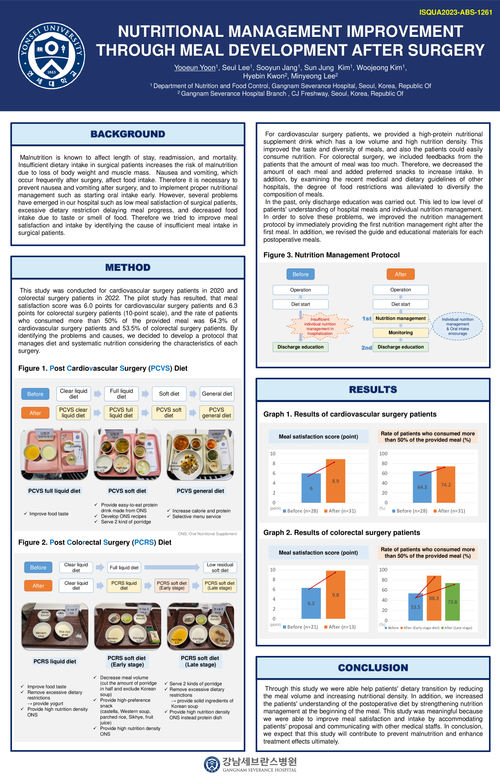
Methods: This study was conducted for cardiovascular surgery patients in 2020 and colorectal surgery patients in 2022. The pilot study has resulted, that meal satisfaction score was 6.0 points for cardiovascular surgery patients and 6.3 points for colorectal surgery patients (10-point scale), and the rate of patients who consumed more than 50% of the provided meal was 64.3% of cardiovascular surgery patients and 53.5% of colorectal surgery patients. By identifying the problems and causes, we decided to develop a protocol that manages diet and systematic nutrition considering the characteristics of each surgery.
For cardiovascular surgery patients, we provided a high-protein nutritional supplement drink which has a low volume and high nutrition density. This improved the taste and diversity of meals, and also the patients could easily consume nutrition. For colorectal surgery, we included feedbacks from the patients that the amount of meal was too much. Therefore, we decreased the amount of each meal and added preferred snacks to increase intake. In addition, by examining the recent medical and dietary guidelines of other hospitals, the degree of food restrictions was alleviated to diversify the composition of meals.
In the past, only discharge education was carried out. This led to low level of patients' understanding of hospital meals and individual nutrition management. In order to solve these problems, we improved the nutrition management protocol by immediately providing the first nutrition management right after the first meal. In addition, we revised the guide and educational materials for each postoperative meals.
Results: Meal satisfaction score (10-point scale) was increased by 48.3% (6.0p to 8.9p) after the improvement in cardiovascular surgery patients. For colorectal surgery patients, the score was increased by 53.1% (6.3p to 9.8p) after the improvement.
The rate of patients who consumed more than 50% of the provided meal increased by 9.9%p (64.3% to 74.2%) after the improvement in cardiovascular surgery patients. As for the patients after colorectal cancer surgery, 34.8%p (53.5% to 88.3%) was increased for the early stage diet and 20.3%p (53.5% to 73.8%) for the late stage diet.
Conclusion: Through this study we were able help patients' dietary transition by reducing the meal volume and increasing nutritional density. In addition, we increased the patients' understanding of the postoperative diet by strengthening nutrition management at the beginning of the meal. This study was meaningful because we were able to improve meal satisfaction and intake by accommodating patients' proposal and communicating with other medical staffs. In conclusion, we expect that this study will contribute to prevent malnutrition and enhance treatment effects ultimately.