708 posters, 8 topics, 16 sessions, 1,190 authors, 600 institutions
ePostersLive by SciGen Technologies S.A. All rights reserved.
ISQua's 39th International Conference 2023
August 27 - 30, 2023 | Seoul, Republic of Korea

P843
THE EFFECT OF RAPID RESPONSE TEAM RELATED TO IN - HOSPITAL MORTALITY
Poster Presenter
Authors
Affiliations
Part of Topic
Patient Safety & Quality Improvement
THE EFFECT OF RAPID RESPONSE TEAM RELATED TO IN - HOSPITAL MORTALITY
Ying-Mei Huang* 1 , Lien-en E. Huang2 , Yu-Wei Huang3 , Chih-Wei Hsu1 , Shu-Ching Chi4 , Wen-Shyang Hsieh2 , I-Ting Tsai1 1.Department of Emergency , 2.Medical Quality Department, 3.Department of Critical Care Medicine, 4.Medical Quality Vice Superintendent, E-Da Hospital, Kaohsiung, Taiwan
Preferred presentation method: Poster Display
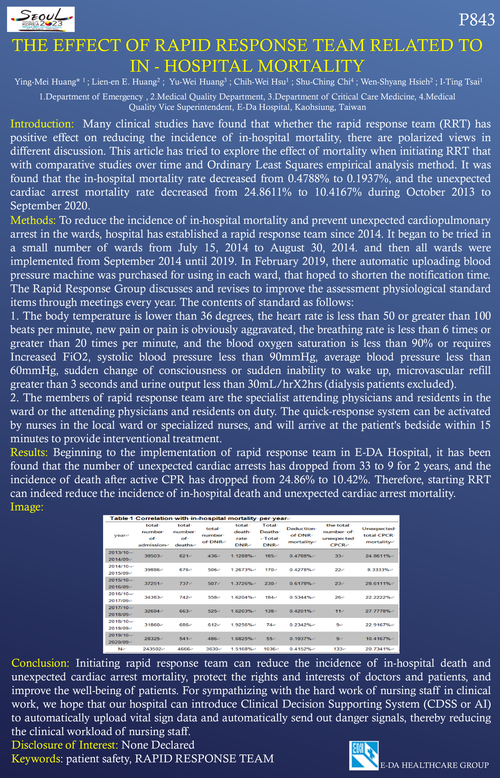
Introduction: Many clinical studies have found that whether the rapid response team (RRT) has positive effect on reducing the incidence of in-hospital mortality, there are polarized views in different discussion. This article has tried to explore the effect of mortality when initiating RRT that with comparative studies over time and Ordinary Least Squares empirical analysis method. It was found that the in-hospital mortality rate decreased from 0.4788% to 0.1937%, and the unexpected cardiac arrest mortality rate decreased from 24.8611% to 10.4167% during October 2013 to September 2020.
Methods: To reduce the incidence of in-hospital mortality and prevent unexpected cardiopulmonary arrest in the wards, hospital has established a rapid response team since 2014. It began to be tried in a small number of wards from July 15, 2014 to August 30, 2014. and then all wards were implemented from September 2014 until 2019. In February 2019, there automatic uploading blood pressure machine was purchased for using in each ward, that hoped to shorten the notification time. The Rapid Response Group discusses and revises to improve the assessment physiological standard items through meetings every year. The contents of standard as follows:
1. The body temperature is lower than 36 degrees, the heart rate is less than 50 or greater than 100 beats per minute, new pain or pain is obviously aggravated, the breathing rate is less than 6 times or greater than 20 times per minute, and the blood oxygen saturation is less than 90% or requires Increased FiO2, systolic blood pressure less than 90mmHg, average blood pressure less than 60mmHg, sudden change of consciousness or sudden inability to wake up, microvascular refill greater than 3 seconds and urine output less than 30mL/hrX2hrs (dialysis patients excluded).
2. The members of rapid response team are the specialist attending physicians and residents in the ward or the attending physicians and residents on duty. The quick-response system can be activated by nurses in the local ward or specialized nurses, and will arrive at the patient's bedside within 15 minutes to provide interventional treatment.
Results: Beginning to the implementation of rapid response team in E-DA Hospital, it has been found that the number of unexpected cardiac arrests has dropped from 33 to 9 for 2 years, and the incidence of death after active CPR has dropped from 24.86% to 10.42%. Therefore, starting RRT can indeed reduce the incidence of in-hospital death and unexpected cardiac arrest mortality.
Conclusion: Initiating rapid response team can reduce the incidence of in-hospital death and unexpected cardiac arrest mortality, protect the rights and interests of doctors and patients, and improve the well-being of patients. For sympathizing with the hard work of nursing staff in clinical work, we hope that our hospital can introduce Clinical Decision Supporting System (CDSS or AI) to automatically upload vital sign data and automatically send out danger signals, thereby reducing the clinical workload of nursing staff.
Keywords: patient safety, RAPID RESPONSE TEAM