708 posters, 8 topics, 16 sessions, 1,190 authors, 600 institutions
ePostersLive by SciGen Technologies S.A. All rights reserved.
ISQua's 39th International Conference 2023
August 27 - 30, 2023 | Seoul, Republic of Korea

ISQUA2023-ABS-1975
A TAXONOMY OF SAFETY INCIDENT REPORTING IN CARE HOMES
Poster Presenter
Authors
Jason Scott, Kate Sykes, Celia Mason, Katie Brittain, Pam Dawson, Justin Waring, Lesley Young-Murphy, Mel Steer, Craig Newman, Michele Spencer
Affiliations
Northumbria University, Northumbria University, UK, Newcastle University, UK, Plymouth Marjon University, UK, Birmingham University, UK, North Tyneside Community Forum, UK
Part of Topic
Patient Safety & Quality Improvement
Introduction and aim
Significant effort has been made to develop robust safety incident reporting systems and for these systems to be implemented in acute healthcare settings, albeit with cultural challenges surrounding incident reporting. Far less is known about safety incident reporting in care home settings, which tend to place a different emphasis on risk management which often exists within safeguarding nomenclature. Care homes exist in a different but interlinked regulatory and fiscal context to healthcare settings with large numbers of providers of varying sizes and service user profiles.
Taxonomies are used for organising and classifying multiple and complex data sources in the same domain and can categorise information in a hierarchical structure. This study aimed to develop a taxonomy of incident reporting processes, systems and policies within care home settings.
Methods
The taxonomy was developed as part of a mixed methods study, Safe Systems Transition (SafeST), drawing on data collected exclusively for the purposes of taxonomy development. Data were obtained from three sources:
Structured interviews (N=75) with care home staff in England
Systematic review of literature (N=124) on incident reporting in care homes internationally
Review of care home incident reporting policies in England (N=26) obtained from interview participants and desk-based internet searches.
The taxonomy was developed following an established process for taxonomy development using a conceptual-to-empirical pathway, with each of the three data sources forming individual sequential iterations of the taxonomy until subjective and objective ending conditions were met.
Final taxonomy
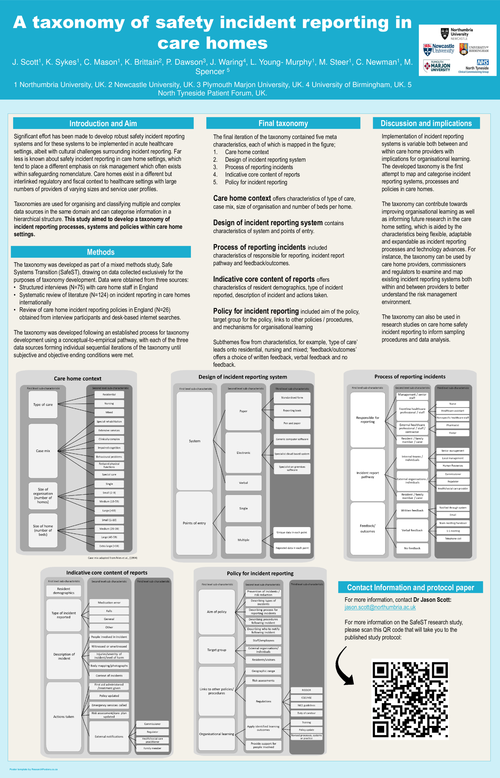
The final iteration of the taxonomy contained five meta characteristics, each of which is mapped in the figure;
Care home context offers characteristics of type of care, case mix, size of organisation and number of beds per home.
Design of incident reporting system contains characteristics of system and points of entry.
Process of reporting incidents included characteristics of responsible for reporting, incident report pathway and feedback/outcomes.
Indicative core content of reports offers characteristics of resident demographics, type of incident reported, description of incident and actions taken.
Policy for incident reporting included aim of the policy, target group for the policy, links to other policies / procedures, and mechanisms for organisational learning
Subthemes flow from characteristics, for example, ‘type of care’ leads onto residential, nursing and mixed; ‘feedback/outcomes’ offers a choice of written feedback, verbal feedback and no feedback.
Discussion and implications
Implementation of incident reporting systems is variable both between and within care home providers with implications for organisational learning. The developed taxonomy is the first attempt to map and categorise incident reporting systems, processes and policies in care homes.
The taxonomy can contribute towards improving organisational learning as well as informing future research in the care home setting, which is aided by the characteristics being flexible, adaptable and expandable as incident reporting processes and technology advances. For instance, the taxonomy can be used by care home providers, commissioners and regulators to examine and map existing incident reporting systems both within and between providers to better understand the risk management environment.
The taxonomy can also be used in research studies on care home safety incident reporting to inform sampling procedures and data analysis.