708 posters, 8 topics, 16 sessions, 1,190 authors, 600 institutions
ePostersLive by SciGen Technologies S.A. All rights reserved.
ISQua's 39th International Conference 2023
August 27 - 30, 2023 | Seoul, Republic of Korea

P829
Day Surgery Model Post COVID-19 pandemic resolution projects.
Poster Presenter
Authors
Affiliations
Part of Topic
Patient Safety & Quality Improvement
Day Surgery Model Post COVID-19 pandemic resolution projects.
<INTRODUCTION>
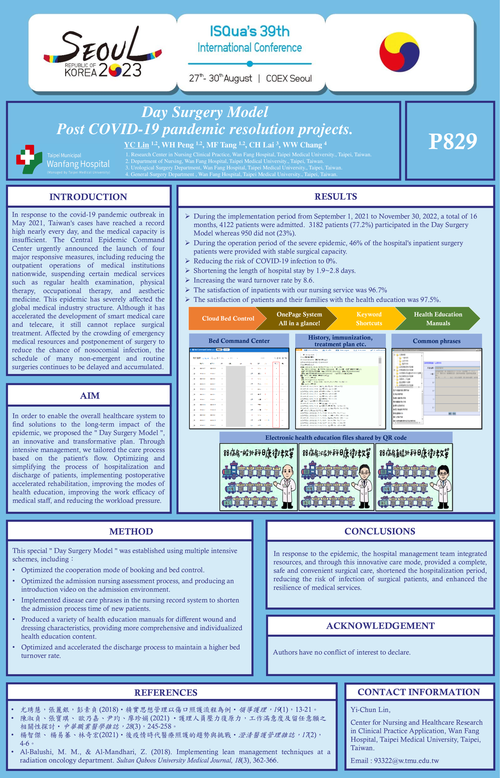
In response to the covid-19 pandemic outbreak in May 2021, Taiwan's cases have reached a record high nearly every day, and the medical capacity is insufficient. The Central Epidemic Command Center urgently announced the launch of four major responsive measures, including reducing the outpatient operations of medical institutions nationwide, suspending certain medical services such as regular health examination, physical therapy, occupational therapy, and aesthetic medicine. This epidemic has severely affected the global medical industry structure. Although it has accelerated the development of smart medical care and telecare, it still cannot replace surgical treatment. Affected by the crowding of emergency medical resources and postponement of surgery to reduce the chance of nosocomial infection, the schedule of many non-emergent and routine surgeries continues to be delayed and accumulated.
<AIM>
In order to enable the overall healthcare system to find solutions to the long-term impact of the epidemic, we proposed the " Day Surgery Model ", an innovative and transformative plan. Through intensive management, we tailored the care process based on the patient's flow. Optimizing and simplifying the process of hospitalization and discharge of patients, implementing postoperative accelerated rehabilitation, improving the modes of health education, improving the work efficacy of medical staff, and reducing the workload pressure.
<METHOD>
This special " Day Surgery Model " was established using multiple intensive schemes, including:
<RESULTS>
In response to the epidemic, the hospital management team integrated resources, and through this innovative care mode, provided a complete, safe and convenient surgical care, shortened the hospitalization period, reducing the risk of infection of surgical patients, and enhanced the resilience of medical services.