708 posters, 8 topics, 16 sessions, 1,190 authors, 600 institutions
ePostersLive by SciGen Technologies S.A. All rights reserved.
ISQua's 39th International Conference 2023
August 27 - 30, 2023 | Seoul, Republic of Korea

P827
A NOVEL MULTI-DOMAIN INTEGRATED INFECTION PREVENTION AND CONTROL (IPC) ASSESSMENT TOOL TO IMPROVE PATIENT SAFETY AND HEALTHCARE QUALITY FOR TERTIARY CARE HOSPITALS WORLDWIDE
Poster Presenter
Authors
Eric WOO KIT SEONG, Yew Fong Lee, Gayathri Thanabalan, Dharmesh Doshi, Hie Ung Ngian, Shu Ching Teo, Yek Kee Chor, Dayang Aida, Abdul Rahim Abdullah
Affiliations
ECRI, School of Medical and Life Sciences, Sunway University, Malaysia, Sarawak General Hospital, Ministry of Health, Malaysia, Malaysian Society for Quality in Health, Malaysia
Part of Topic
Patient Safety & Quality Improvement
A NOVEL MULTI-DOMAIN INTEGRATED INFECTION PREVENTION AND CONTROL (IPC) ASSESSMENT TOOL TO IMPROVE PATIENT SAFETY AND HEALTHCARE QUALITY FOR TERTIARY CARE HOSPITALS WORLDWIDE
Woo Kit Seong1, Lee Yew Fong2, Gayathri Thanabalan1, Dharmesh Doshi1, Ngian Hie Ung3, Teo Shu Ching3, ChorYek Kee3, Dayang Aida3,
Abdul Rahim Abdullah4
1 ECRI
2 School of Medical and Life Sciences, Sunway University, Malaysia
3 Sarawak General Hospital, Ministry of Health, Malaysia
4Malaysian Society for Quality in Health, Malaysia
Background
The recent pandemic sparked discussions on the adequacy of existing Infection Prevention & Control (IPC) policies and practices in managing infectious disease outbreaks. To enable proactive management of IPC, an integrated approach that considers the myriad of domains related to infection control and takes into account different care processes and workflows in clinical areas should be used, as generic guidelines of IPC may not address every specific situation or setting. ECRI has developed a novel multi-domain integrated IPC assessment tool to comprehend granular-level indicators related to IPC. The assessment also provides an opportunity for the facility to be better prepared in meeting hospital accreditation requirements.
Aims
Methodology
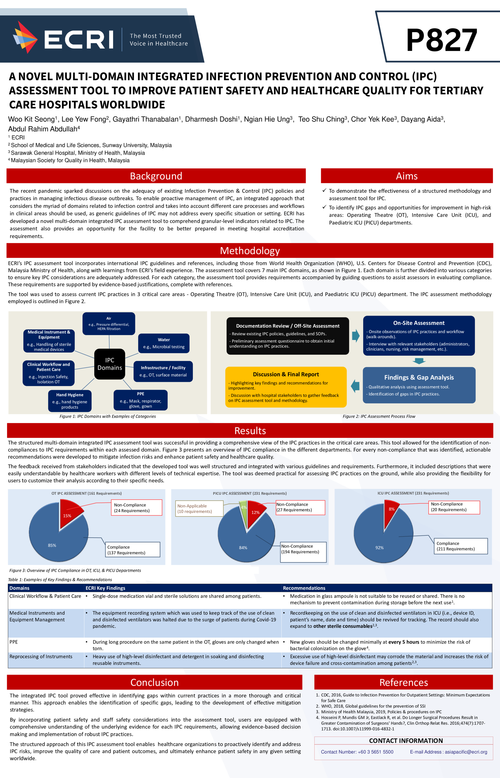
ECRI’s IPC assessment tool incorporates international IPC guidelines and references, including those from World Health Organization (WHO), U.S. Centers for Disease Control and Prevention (CDC), Malaysia Ministry of Health, along with learnings from ECRI’s field experience. The assessment tool covers 7 main IPC domains, as shown in Figure 1. Each domain is further divided into various categories to ensure key IPC considerations are adequately addressed. For each category, the assessment tool provides requirements accompanied by guiding questions to assist assessors in evaluating compliance. These requirements are supported by evidence-based justifications, complete with references.
The tool was used to assess current IPC practices in 3 critical care areas - Operating Theatre (OT), Intensive Care Unit (ICU), and Paediatric ICU (PICU) department. The IPC assessment methodology employed is outlined in Figure 2.
Results
The structured multi-domain integrated IPC assessment tool was successful in providing a comprehensive view of the IPC practices in the critical care areas. This tool allowed for the identification of non-compliances to IPC requirements within each assessed domain. Figure 3 presents an overview of IPC compliance in the different departments. For every non-compliance that was identified, actionable recommendations were developed to mitigate infection risks and enhance patient safety and healthcare quality.
The feedback received from stakeholders indicated that the developed tool was well structured and integrated with various guidelines and requirements. Furthermore, it included descriptions that were easily understandable by healthcare workers with different levels of technical expertise. The tool was deemed practical for assessing IPC practices on the ground, while also providing the flexibility for users to customize their analysis according to their specific needs.
Conclusion
The integrated IPC tool proved effective in identifying gaps within current practices in a more thorough and critical manner. This approach enables the identification of specific gaps, leading to the development of effective mitigation strategies.
By incorporating patient safety and staff safety considerations into the assessment tool, users are equipped with comprehensive understanding of the underlying evidence for each IPC requirements, allowing evidence-based decision making and implementation of robust IPC practices.
The structured approach of this IPC assessment tool enables healthcare organizations to proactively identify and address IPC risks, improve the quality of care and patient outcomes, and ultimately enhance patient safety in any given setting worldwide.
References