708 posters, 8 topics, 16 sessions, 1,190 authors, 600 institutions
ePostersLive by SciGen Technologies S.A. All rights reserved.
ISQua's 39th International Conference 2023
August 27 - 30, 2023 | Seoul, Republic of Korea

P826
LIVER CANCER SURGICAL MORTALITY ASSESSMENT IN SOUTH KOREA
Poster Presenter
Authors
Affiliations
Part of Topic
Patient Safety & Quality Improvement
INTRODUCTION
• Cancer is the number 1 cause of death in Korea, and among them, liver cancer is the 2nd cause of cancer mortality.
• Accordingly, the Health Insurance Review and Assessment Service of the Republic of Korea started liver cancer surgery mortality assessment in 2014 to manage the quality of liver cancer medical services.
• After the 1st assessment was performed from July 2014 to June 2015 (1 year), the 2nd to 4th assessments were conducted in units of 2 years from July 2015 to June 2021.
AIM
• The purpose of this study is to provide information on the total liver cancer surgery mortality rate to the public through liver cancer surgery mortality assessment.
• This is to induce voluntary quality management of liver cancer surgery medical services by providing information on the surgical mortality rate by medical institution.
METHOD
1. Data Sources
• In order to evaluate liver cancer surgery mortality, we used health insurance review and assessment service (HIRA) claims data and death-related data from the Ministry of the Interior and Safety.
- Claimed data: Data on inpatients aged 18 years or older who underwent surgery for liver cancer from July 2014 to June 2021
- Death-related data: death and date of death
2. Calculation of Actual Surgical Mortality
• Of the 41,638 liver resection cases, the final 41,189 cases, excluding 449 cases including Klatskin Tumor et al., and 471 cases of patients who died within hospitalization or 30 days after surgery were analyzed to calculate the actual liver cancer surgical mortality rate.
• Formula
(After undergoing hepatectomy, within hospitalization or Number of patients who died within 30 days of surgery/Number of patients who underwent hepatectomy) × 100 (%)
RESULTS
• Liver cancer actual surgery mortality rate
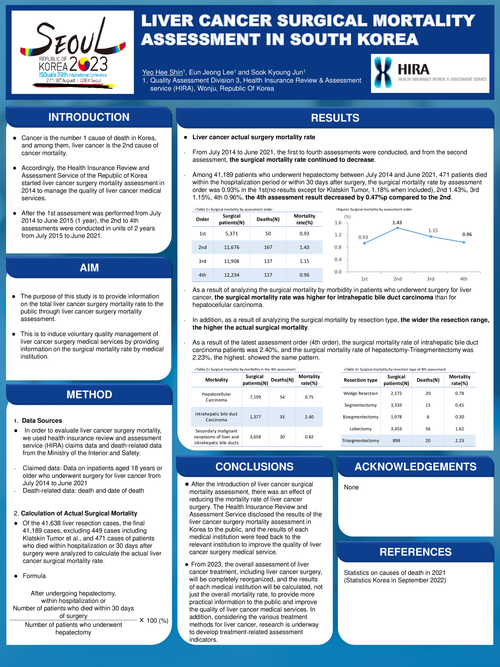
- From July 2014 to June 2021, the first to fourth assessments were conducted, and from the second assessment, the surgical mortality rate continued to decrease.
- Among 41,189 patients who underwent hepatectomy between July 2014 and June 2021, 471 patients died within the hospitalization period or within 30 days after surgery, the surgical mortality rate by assessment order was 0.93% in the 1st(no results except for Klatskin Tumor, 1.18% when included), 2nd 1.43%, 3rd 1.15%, 4th 0.96%, the 4th assessment result decreased by 0.47%p compared to the 2nd.
- As a result of analyzing the surgical mortality by morbidity in patients who underwent surgery for liver cancer, the surgical mortality rate was higher for intrahepatic bile duct carcinoma than for hepatocellular carcinoma.
- In addition, as a result of analyzing the surgical mortality by resection type, the wider the resection range, the higher the actual surgical mortality.
- As a result of the latest assessment order (4th order), the surgical mortality rate of intrahepatic bile duct carcinoma patients was 2.40%, and the surgical mortality rate of hepatectomy-Trisegmentectomy was 2.23%, the highest. showed the same pattern.
CONCLUSIONS
• After the introduction of liver cancer surgical mortality assessment, there was an effect of reducing the mortality rate of liver cancer surgery. The Health Insurance Review and Assessment Service disclosed the results of the liver cancer surgery mortality assessment in Korea to the public, and the results of each medical institution were feed back to the relevant institution to improve the quality of liver cancer surgery medical service.
• From 2023, the overall assessment of liver cancer treatment, including liver cancer surgery, will be completely reorganized, and the results of each medical institution will be calculated, not just the overall mortality rate, to provide more practical information to the public and improve the quality of liver cancer medical services. In addition, considering the various treatment methods for liver cancer, research is underway to develop treatment-related assessment indicators.
ACKNOWLEDGEMENTS
None
REFERENCES
Statistics on causes of death in 2021(Statistics Korea in September 2022)