708 posters, 8 topics, 16 sessions, 1,190 authors, 600 institutions
ePostersLive by SciGen Technologies S.A. All rights reserved.
ISQua's 39th International Conference 2023
August 27 - 30, 2023 | Seoul, Republic of Korea

P825
SHORTENING THE PREOPERATIVE FOR UNANTICIPATED COVID CAESAREAN SECTION PREPARATION TIME
Poster Presenter
Authors
Affiliations
Part of Topic
Patient Safety & Quality Improvement
For women who go into labor late in their pregnancy, contracting COVID-19 will reduce their expiratory and inspiratory reserve volume and lead to changes in their residual volume. In addition, vaginal deliveries are difficult to control and can predispose laboring women to an increased cardiopulmonary burden and oxygen consumption, thus heightening their risk of severe hypoxemia.
Therefore, cesarean deliveries are commonly prescribed in these cases to seize the optimal time window for treatment. In light of this, the hospital implemented an organizational overhaul to reduce the preoperative preparation time for unplanned cesarean sections among women with COVID-19, in order to ensure safe childbirths.
This project is implemented an organizational overhaul to reduce the preoperative preparation time for unplanned cesarean sections among women with COVID-19.
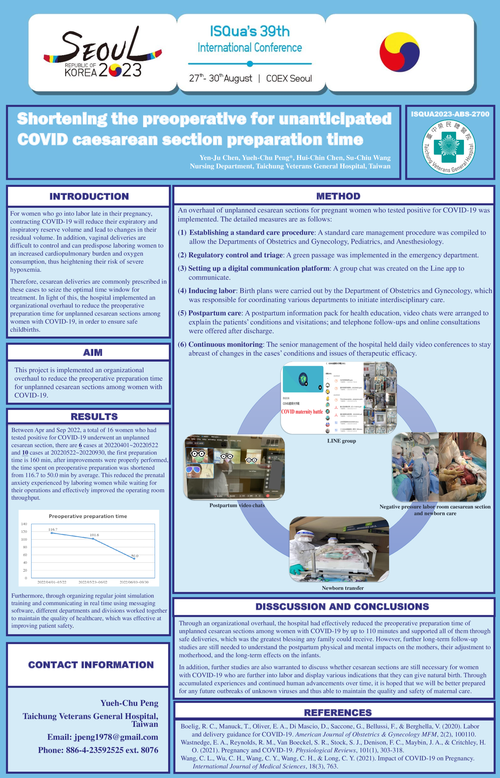
An overhaul of unplanned cesarean sections for pregnant women who tested positive for COVID-19 was implemented. The detailed measures are as follows:(1)Establishing a standard care procedure. (2) Regulatory control and triage. (3) Setting up a digital communication platform. (4) Inducing labor. (5) Remote postpartum care. (6) Continuous monitoring.
Between Apr and Sep 2022, a total of 16 women who had tested positive for COVID-19 underwent an unplanned cesarean section, there are 6 cases at 20220401~20220522 and 10 cases at 20220522~20220930, the first preparation time is 160 min, after improvements were properly performed, the time spent on preoperative preparation was shortened from 116.7 to 50.0 min by average. This reduced the prenatal anxiety experienced by laboring women while waiting for their operations and effectively improved the operating room throughput.
Through an organizational overhaul, the hospital had effectively reduced the preoperative preparation time of unplanned cesarean sections among women with COVID-19 by up to 110 minutes and supported all of them through safe deliveries, which was the greatest blessing any family could receive. However, further long-term follow-up studies are still needed to understand the postpartum physical and mental impacts on the mothers, their adjustment to motherhood, and the long-term effects on the infants.
In addition, further studies are also warranted to discuss whether cesarean sections are still necessary for women with COVID-19 who are further into labor and display various indications that they can give natural birth. Through accumulated experiences and continued human advancements over time, it is hoped that we will be better prepared for any future outbreaks of unknown viruses and thus able to maintain the quality and safety of maternal care.