708 posters, 8 topics, 16 sessions, 1,190 authors, 600 institutions
ePostersLive by SciGen Technologies S.A. All rights reserved.
ISQua's 39th International Conference 2023
August 27 - 30, 2023 | Seoul, Republic of Korea

P821
APPLYING DIVERSIFIED STRATEGIES TO REDUCE THE INCIDENCE OF FALLS IN HOSPITALIZED PATIENTS
Poster Presenter
Authors
Affiliations
Part of Topic
Patient Safety & Quality Improvement
Applying diversified strategies to reduce the incidence of falls in hospitalized patients
Ya-Han Yang 1, Yi-Tseng Tsai 1
1 Department of Nursing, An Nan Hospital, China Medical University, Tainan, Taiwan, Tainan, Taiwan
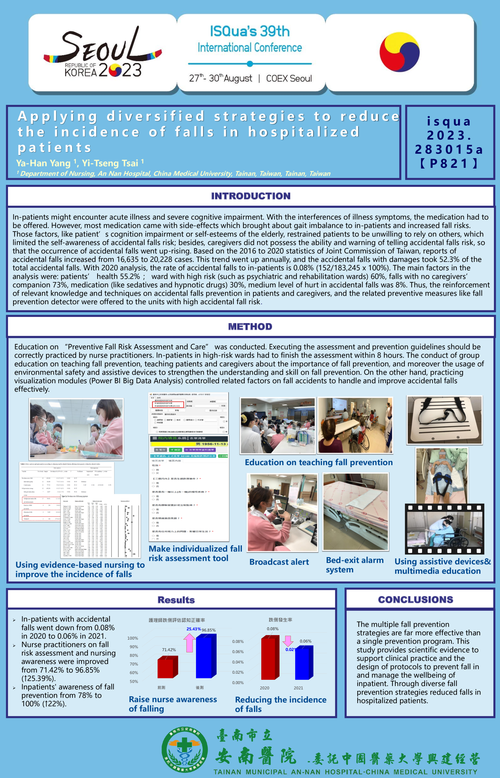
In-patients might encounter acute illness and severe cognitive impairment. With the interferences of illness symptoms, the medication had to be offered. However, most medication came with side-effects which brought about gait imbalance to in-patients and increased fall risks. Those factors, like patient’s cognition impairment or self-esteems of the elderly, restrained patients to be unwilling to rely on others, which limited the self-awareness of accidental falls risk; besides, caregivers did not possess the ability and warning of telling accidental falls risk, so that the occurrence of accidental falls went up-rising. Based on the 2016 to 2020 statistics of Joint Commission of Taiwan, reports of accidental falls increased from 16,635 to 20,228 cases. This trend went up annually, and the accidental falls with damages took 52.3% of the total accidental falls. With 2020 analysis, the rate of accidental falls to in-patients is 0.08% (152/183,245 x 100%). The main factors in the analysis were: patients’ health 55.2% ; ward with high risk (such as psychiatric and rehabilitation wards) 60%, falls with no caregivers’ companion 73%, medication (like sedatives and hypnotic drugs) 30%, medium level of hurt in accidental falls was 8%. Thus, the reinforcement of relevant knowledge and techniques on accidental falls prevention in patients and caregivers, and the related preventive measures like fall prevention detector were offered to the units with high accidental fall risk.