708 posters, 8 topics, 16 sessions, 1,190 authors, 600 institutions
ePostersLive by SciGen Technologies S.A. All rights reserved.
ISQua's 39th International Conference 2023
August 27 - 30, 2023 | Seoul, Republic of Korea

ISQUA2023-ABS-2736
ELECTRONIC RESOURCES TO ADDRESS NEEDS OF PEOPLE WITH RARE DISEASES
Poster Presenter
Authors
Janet LONG, Stephanie Best, John Christodoulou, Jeffrey Braithwaite
Affiliations
Macquarie University, Australian Institute of Health Innovation, Macquarie University, Sydney, Australia, Australian Institute of Health Innovation, Macquarie University, Sydney, Australia.Macquarie University, Australian Institute of Health Innovation, Macquarie University, Sydney, Australia; Dept of Health Services Research, Peter MacCallum Cancer Centre, Melbourne Australia, Brain and Mitochondrial Research Group, Murdoch Children's Research Institute; Department of Paediatrics, University of Melbourne, Melbourne, Australia
Part of Topic
Digital Healthcare and Innovation
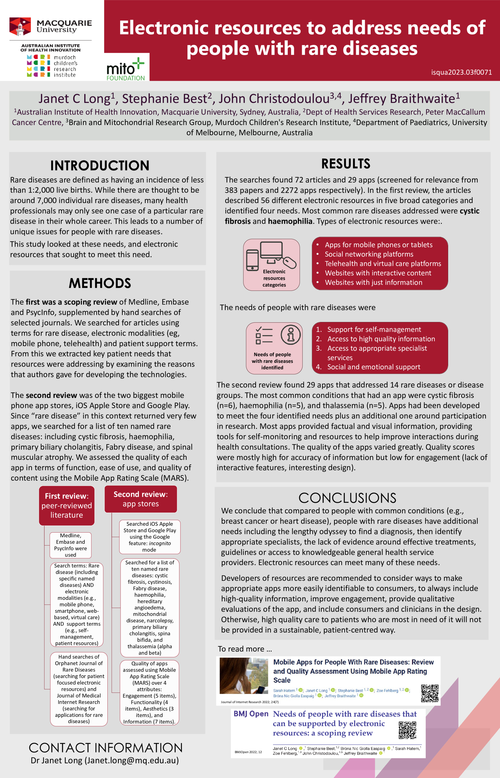
ELECTRONIC RESOURCES TO ADDRESS NEEDS OF PEOPLE WITH RARE DISEASES
Introduction: Rare diseases are defined as having an incidence of less than 1:2,000 births. While there are thought to be
around 7,000 individual rare diseases, many health professionals may only see one case of a particular rare disease in
their whole career. This leads to a number of unique issues for people with rare diseases. This study looked at these
needs, and electronic resources that sought to meet this need.
Methods: We conducted two reviews. The first was a scoping review of Medline, Embase and PsycInfo, supplemented
by hand searches of selected journals. We searched for articles using terms for rare disease, electronic modalities (eg,
mobile phone, telehealth) and patient support terms. From this we extracted key patient needs that resources were
addressing by examining the reasons that authors gave for developing the technologies. The second search was of the
two biggest mobile phone app stores, iOS Apple Store and Google Play. Since “rare disease” in this context returned
very few apps, we searched for a list of ten named rare diseases: including cystic fibrosis, haemophilia, primary biliary
cholangitis, Fabry disease, and spinal muscular atrophy. We assessed the quality of each app in terms of function, ease
of use, and quality of content.
Results: The searches found 72 articles and 29 apps (screened for relevance from 383 papers and 2272 apps
respectively). The articles described 56 different electronic resources in five broad categories: apps, social networking
platforms, telehealth and virtual care platforms, websites with interactive content, and websites with just information. Most
common rare diseases addressed were cystic fibrosis and haemophilia. Needs identified were support for selfmanagement,
access to high-quality information, access to appropriate specialist services, and social support. Apps we
found had been developed to meet those needs. Quality scores were mostly high for accuracy of information but low for
engagement (lack of interactive features, interesting design).
Conclusion: We concluded that while people with common conditions (e.g., breast cancer or heart disease) may have
similar levels of distress and similarly onerous self-management routines, people with rare diseases have additional
needs: the lengthy odyssey to find a diagnosis, then identify appropriate specialists, the lack of evidence around effective
treatments, guidelines or access to knowledgeable general health service providers. Electronic resources can meet many
of these needs. We recommend the use of a web designer to make sure apps are engaging and of high quality, and are
co-designed with people with lived experience. Otherwise, high quality care to patients who are most in need of it will not
be provided in a sustainable, patient-centred way.