708 posters, 8 topics, 16 sessions, 1,190 authors, 600 institutions
ePostersLive by SciGen Technologies S.A. All rights reserved.
ISQua's 39th International Conference 2023
August 27 - 30, 2023 | Seoul, Republic of Korea

P803
IMPROVING THE RATE AND PROCESSING TIME OF RETURNING MEDICINES BY QUALITY CONTROL CIRCLE IN THE REGIONAL HOSPITAL OF SOUTHERN TAIWAN
Poster Presenter
Authors
Affiliations
Part of Topic
Patient Safety & Quality Improvement
Introduction
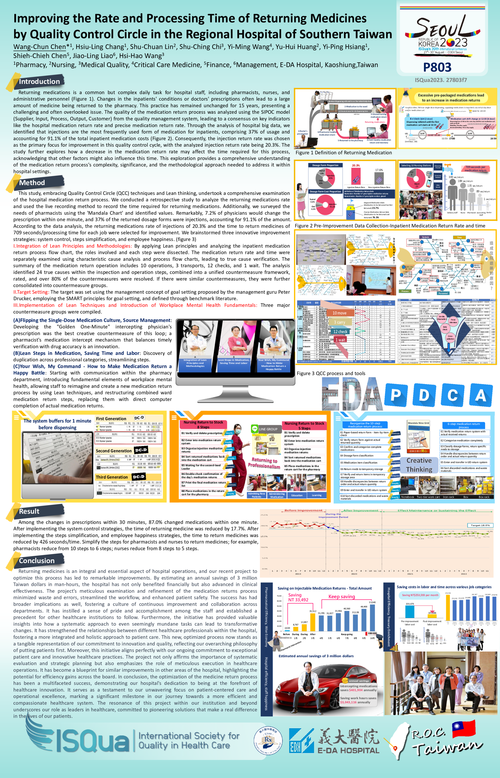
Returning medications is a common but complex daily task for hospital staff, including pharmacists, nurses, and administrative personnel (Figure 1). Changes in the inpatients' conditions or doctors' prescriptions often lead to a large amount of medicine being returned to the pharmacy. This practice has remained unchanged for 15 years, presenting a challenging and often overlooked issue. The quality of the medication return process was analyzed using the SIPOC model (Supplier, Input, Process, Output, Customer) from the quality management system, leading to a consensus on key indicators like the hospital medication return rate and precise medication return rate. Through the analysis of hospital big data, we identified that injections are the most frequently used form of medication for inpatients, comprising 37% of usage and accounting for 91.1% of the total inpatient medication costs (Figure 2). Consequently, the injection return rate was chosen as the primary focus for improvement in this quality control cycle, with the analyzed injection return rate being 20.3%. The study further explores how a decrease in the medication return rate may affect the time required for this process, acknowledging that other factors might also influence this time. This exploration provides a comprehensive understanding of the medication return process's complexity, significance, and the methodological approach needed to address it within hospital settings.
Method
This study, embracing Quality Control Circle (QCC) techniques and Lean thinking, undertook a comprehensive examination of the hospital medication return process. We conducted a retrospective study to analyze the returning medications rate and used the live recording method to record the time required for returning medications. Additionally, we surveyed the needs of pharmacists using the 'Mandala Chart' and identified values. Remarkably, 7.2% of physicians would change the prescription within one minute, and 37% of the returned dosage forms were injections, accounting for 91.1% of the amount. According to the data analysis, the returning medications rate of injections of 20.3% and the time to return medicines of 709 seconds/processing time for each job were selected for improvement. We brainstormed three innovative improvement strategies: system control, steps simplification, and employee happiness. (figure 3)
I.Integration of Lean Principles and Methodologies: By applying Lean principles and analyzing the inpatient medication return process flow chart, the roles involved and each step were dissected. The medication return rate and time were separately examined using characteristic cause analysis and process flow charts, leading to true cause verification. The summary of the medication return operation includes 10 operations, 3 transports, 12 checks, and 1 wait. The analysis identified 24 true causes within the inspection and operation steps, combined into a unified countermeasure framework, rated, and over 80% of the countermeasures were resolved. If there were similar countermeasures, they were further consolidated into countermeasure groups.
II.Target Setting: The target was set using the management concept of goal setting proposed by the management guru Peter Drucker, employing the SMART principles for goal setting, and defined through benchmark literature.
III.Implementation of Lean Techniques and Introduction of Workplace Mental Health Fundamentals: Three major countermeasure groups were compiled.
(A)Flipping the Single-Dose Medication Culture, Source Management: Developing the "Golden One-Minute" intercepting physician's prescription was the best creative countermeasure of this loop; a pharmacist's medication intercept mechanism that balances timely verification with drug accuracy is an innovation.
(B)Lean Steps in Medication, Saving Time and Labor: Discovery of duplication across professional categories, streamlining steps.
(C)Your Wish, My Command - How to Make Medication Return a Happy Battle: Starting with communication within the pharmacy department, introducing fundamental elements of workplace mental health, allowing staff to reimagine and create a new medication return process by using Lean techniques, and restructuring combined ward medication return steps, replacing them with direct computer completion of actual medication returns.
Result
Among the changes in prescriptions within 30 minutes, 87.0% changed medications within one minute. After implementing the system control strategies, the time of returning medicine was reduced by 17.7%. After implementing the steps simplification, and employee happiness strategies, the time to return medicines was reduced by 426 seconds/time. Simplify the steps for pharmacists and nurses to return medicines; for example, pharmacists reduce from 10 steps to 6 steps; nurses reduce from 8 steps to 5 steps.
Conclusion
Returning medicines is an integral and essential aspect of hospital operations, and our recent project to optimize this process has led to remarkable improvements. By estimating an annual savings of 3 million Taiwan dollars in man-hours, the hospital has not only benefited financially but also advanced in clinical effectiveness. The project's meticulous examination and refinement of the medication returns process minimized waste and errors, streamlined the workflow, and enhanced patient safety. The success has had broader implications as well, fostering a culture of continuous improvement and collaboration across departments. It has instilled a sense of pride and accomplishment among the staff and established a precedent for other healthcare institutions to follow. Furthermore, the initiative has provided valuable insights into how a systematic approach to even seemingly mundane tasks can lead to transformative changes. It has strengthened the relationships between different healthcare professionals within the hospital, fostering a more integrated and holistic approach to patient care. This new, optimized process now stands as a tangible representation of our commitment to innovation and quality, reflecting our overarching philosophy of putting patients first. Moreover, this initiative aligns perfectly with our ongoing commitment to exceptional patient care and innovative healthcare practices. The project not only affirms the importance of systematic evaluation and strategic planning but also emphasizes the role of meticulous execution in healthcare operations. It has become a blueprint for similar improvements in other areas of the hospital, highlighting the potential for efficiency gains across the board. In conclusion, the optimization of the medicine return process has been a multifaceted success, demonstrating our hospital's dedication to being at the forefront of healthcare innovation. It serves as a testament to our unwavering focus on patient-centered care and operational excellence, marking a significant milestone in our journey towards a more efficient and compassionate healthcare system. The resonance of this project within our institution and beyond underscores our role as leaders in healthcare, committed to pioneering solutions that make a real difference in the lives of our patients.