708 posters, 8 topics, 16 sessions, 1,190 authors, 600 institutions
ePostersLive by SciGen Technologies S.A. All rights reserved.
ISQua's 39th International Conference 2023
August 27 - 30, 2023 | Seoul, Republic of Korea

P800
THE SECOND VICTIM PHENOMENON IN GERMANY - PREVALENCE AND SUPPORT STRATEGIES FROM THE GERMAN PERSPECTIVE
Poster Presenter
Authors
Affiliations
Part of Topic
Patient Safety & Quality Improvement
The Second Victim Phenomenon in Germany - Prevalence and Support Strategies from the German Perspective.
Klemm, Victoria1; Rösner, Hannah1; Marung, Hartwig2; Strametz, Reinhard1
Introduction. A Second Victim (SV) is any health care worker involved in an unanticipated adverse patient event, health care error or patient injury, who is negatively impacted by it due to traumatization. SVs can develop dysfunctional coping strategies, e.g., depression, substance abuse, isolation, leading to reduced quality of care for future patients. Three studies were conducted to gain knowledge of the Second Victim Phenomenon (SVP) in Germany, using the SeViD (Second Victims in German-speaking countries) questionnaire. The studies focused on different occupational groups such as: Young German physicians in internal medicine (SeViD-I), nurses (SeViD-II), and Emergency Medical Services (EMS) physicians in Germany (SeViD-III).
Methods. SeViD-I-III were cross-sectional online surveys carried out in 2019, 2020 and 2022. The surveys contained 46 items. SeViD II and III additionally included BFI-10 to identify risk factors for prevalence and symptom load and explicitly assessed influence of the COVID-19 pandemic. Binary logistics regression models were carried out to study various factors’ influence on different dimensions of the questionnaires, such as the risk of becoming SV, symptom load or time of self-perceived recovery.
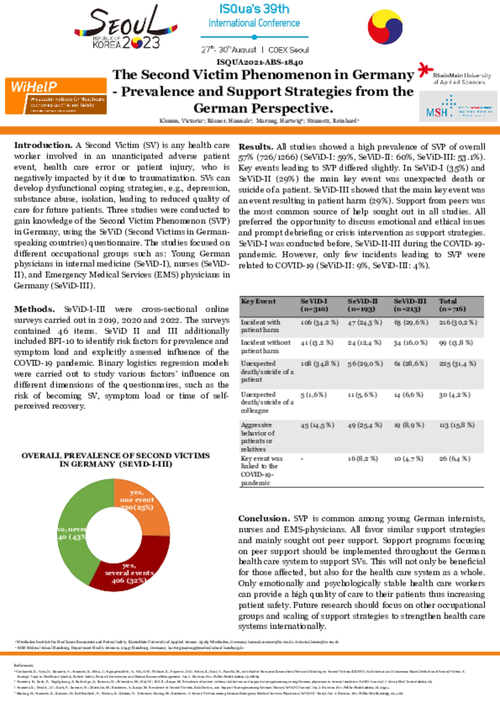
Results. All studies showed a high prevalence of SVP of overall 57% (726/1266) (SeViD-I: 59%, SeViD-II: 60%, SeViD-III: 53.1%). Key events leading to SVP differed slightly. In SeViD-I (35%) and SeViD-II (29%) the main key event was unexpected death or suicide of a patient. SeViD-III showed that the main key event was an event resulting in patient harm (29%). Support from peers was the most common source of help sought out in all studies. All preferred the opportunity to discuss emotional and ethical issues and prompt debriefing or crisis intervention as support strategies. SeViD-I was conducted before, SeViD-II-III during the COVID-19-pandemic. However, only few incidents leading to SVP were related to COVID-19 (SeViD-II: 9%, SeViD-III: 4%).
Conclusion. SVP is common among young German internists, nurses and EMS-physicians. All favor similar support strategies and mainly sought out peer support. Support programs focusing on peer support should be implemented throughout the German health care system to support SVs. This will not only be beneficial for those affected, but also for the health care system as a whole. Only emotionally and psychologically stable health care workers can provide a high quality of care to their patients thus increasing patient safety. Future research should focus on other occupational groups and scaling of support strategies to strengthen health care systems internationally.