708 posters, 8 topics, 16 sessions, 1,190 authors, 600 institutions
ePostersLive by SciGen Technologies S.A. All rights reserved.
ISQua's 39th International Conference 2023
August 27 - 30, 2023 | Seoul, Republic of Korea

P799
A QUALITATIVE STAKEHOLDER ANALYSIS OF ACTORS INVOLVED IN RESILIENCE IN HEALTHCARE
Poster Presenter
Authors
Veslemøy GUISE, Cecilie Haraldseid-Driftland, Hilda Bø Lyng, Siri Wiig
Affiliations
Part of Topic
Patient Safety & Quality Improvement
A qualitative stakeholder analysis of actors involved in resilience in healthcare
Background
Resilience in healthcare is defined as the capacity to adapt to challenges and changes to maintain high quality care across system levels. Diverse healthcare system stakeholders are acknowledged as important co-creators of resilient healthcare systems. However, more research is needed to understand how these different stakeholders come to facilitate and support resilience and the circumstances and context in which this happens.
Aims
To identify and categorise stakeholders that are key to facilitating and sustaining resilience in healthcare, and to investigate stakeholder relationships relevant for the enactment of resilient healthcare systems.
Research Questions
1.Which healthcare system stakeholders are involved in facilitating resilience in healthcare?
2.How do different stakeholders influence the adaptations that contribute to resilience in healthcare?
3.What characterizes the relationships between the stakeholders involved in facilitating resilience in healthcare?
Methods
A stakeholder analysis was conducted using a sample of 19 empirical research projects from the Norwegian healthcare setting. The data material consisted of 14 narrative summaries, in addition to 16 individual interviews with researchers from the 19 projects. Application of stakeholder analysis methods was done according to the following three steps: a)identification of stakeholders; b)differentiation and categorisation of stakeholders using an interest/influence grid; and c) investigation and mapping stakeholder of relationships using an actor-linkage matrix to assess the degree and type of contact between identified stakeholders.
Results
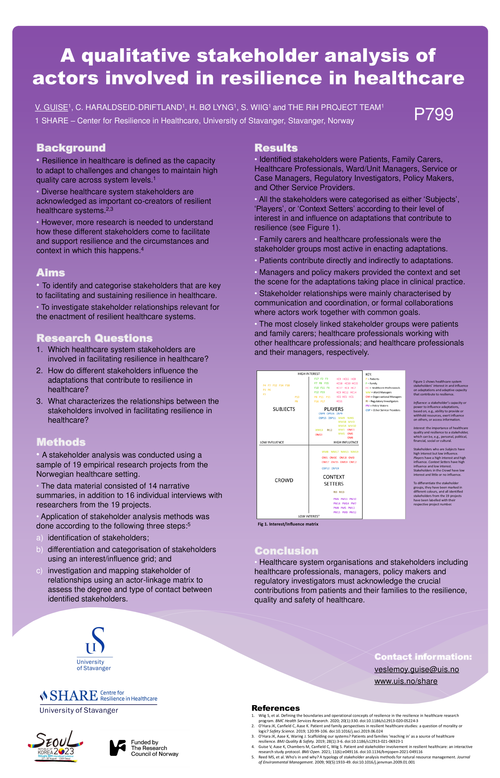
Identified stakeholders were Patients, Family Carers, Healthcare Professionals, Ward/Unit Managers, Service or Case Managers, Regulatory Investigators, Policy Makers, and Other Service Providers. All the stakeholders were categorised as either ‘Subjects’, ‘Players’, or ‘Context Setters’ according to their level of interest in and influence on adaptations that contribute to resilience (see Figure 1). Family carers and healthcare professionals were the stakeholder groups most active in enacting adaptations. Patients contribute directly and indirectly to adaptations. Managers and policy makers provided the context and set the scene for the adaptations taking place in clinical practice. Stakeholder relationships were mainly characterised by communication and coordination, or formal collaborations where actors work together with common goals. The most closely linked stakeholder groups were patients and family carers; healthcare professionals working with other healthcare professionals; and healthcare professionals and their managers, respectively.
Conclusion
Healthcare system organisations and stakeholders including healthcare professionals, managers, policy makers and regulatory investigators must acknowledge the crucial contributions from patients and their families to the resilience, quality and safety of healthcare.