708 posters, 8 topics, 16 sessions, 1,190 authors, 600 institutions
ePostersLive by SciGen Technologies S.A. All rights reserved.
ISQua's 39th International Conference 2023
August 27 - 30, 2023 | Seoul, Republic of Korea

P786
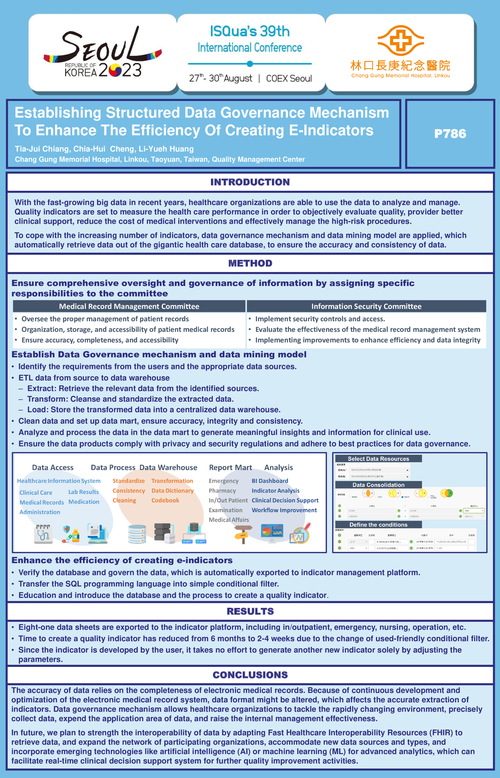
ESTABLISHING STRUCTURED DATA GOVERNANCE MECHANISM TO ENHANCE THE EFFICIENCY OF CREATING E-INDICATORS
Poster Presenter
Authors
Affiliations
Part of Topic
Patient Safety & Quality Improvement
INTRODUCTION
With the fast-growing big data in recent years, healthcare organizations are able to use the data to analyze and manage. Quality indicators are set to measure the health care performance in order to objectively evaluate quality, provider better clinical support, reduce the cost of medical interventions and effectively manage the high-risk procedures.
To cope with the increasing number of indicators, data governance mechanism and data mining model are applied, which automatically retrieve data out of the gigantic health care database, to ensure the accuracy and consistency of data.
METHOD
Ensure comprehensive oversight and governance of information by assigning specific responsibilities to the committee.
Establish Data Governance mechanism and data mining model
Identify the requirements from the users and the appropriate data sources.
ETL data from source to data warehouse
‒Extract: Retrieve the relevant data from the identified sources.
‒Transform: Cleanse and standardize the extracted data.
‒Load: Store the transformed data into a centralized data warehouse.
Clean data and set up data mart, ensure accuracy, integrity and consistency.
Analyze and process the data in the data mart to generate meaningful insights and information for clinical use.
Ensure the data products comply with privacy and security regulations and adhere to best practices for data governance.
Enhance the efficiency of creating e-indicators
Verify the database and govern the data, which is automatically exported to indicator management platform.
Transfer the SQL programming language into simple conditional filter.
Education and introduce the database and the process to create a quality indicator.
Eight-one data sheets are exported to the indicator platform, including in/outpatient, emergency, nursing, operation, etc.
Time to create a quality indicator has reduced from 6 months to 2-4 weeks due to the change of used-friendly conditional filter.
Since the indicator is developed by the user, it takes no effort to generate another new indicator solely by adjusting the parameters.
RESULTS
The accuracy of data relies on the completeness of electronic medical records. Because of continuous development and optimization of the electronic medical record system, data format might be altered, which affects the accurate extraction of indicators. Data governance mechanism allows healthcare organizations to tackle the rapidly changing environment, precisely collect data, expend the application area of data, and raise the internal management effectiveness.
CONCLUSIONS
In future, we plan to strength the interoperability of data by adapting Fast Healthcare Interoperability Resources (FHIR) to retrieve data, and expand the network of participating organizations, accommodate new data sources and types, and incorporate emerging technologies like artificial intelligence (AI) or machine learning (ML) for advanced analytics, which can facilitate real-time clinical decision support system for further quality improvement activities.