708 posters, 8 topics, 16 sessions, 1,190 authors, 600 institutions
ePostersLive by SciGen Technologies S.A. All rights reserved.
ISQua's 39th International Conference 2023
August 27 - 30, 2023 | Seoul, Republic of Korea

P772
IMPLEMENTATION OF LEAN IN STEMI MANAGEMENT AND PRIMARY PERCUTANEOUS CORONARY INTERVENTION (PRIMARY PCI) PROCESS FLOW IN KPJ SELANGOR ACCIDENT AND EMERGENCY DEPARTMENT
Poster Presenter
Authors
Affiliations
Part of Topic
Patient Safety & Quality Improvement
Implementation of LEAN in STEMI Management and Primary Percutaneous Coronary Intervention (Primary PCI) process flow in KPJ Selangor Accident and Emergency Department
Sumaria, A. M., Wan Khadijah, W. Y. , Siti Hawa, A. H. (KPJ Selangor Specialist Hospital, Jalan Singa 20/1, 40000 Shah Alam, Selangor, MALAYSIA)
Introduction
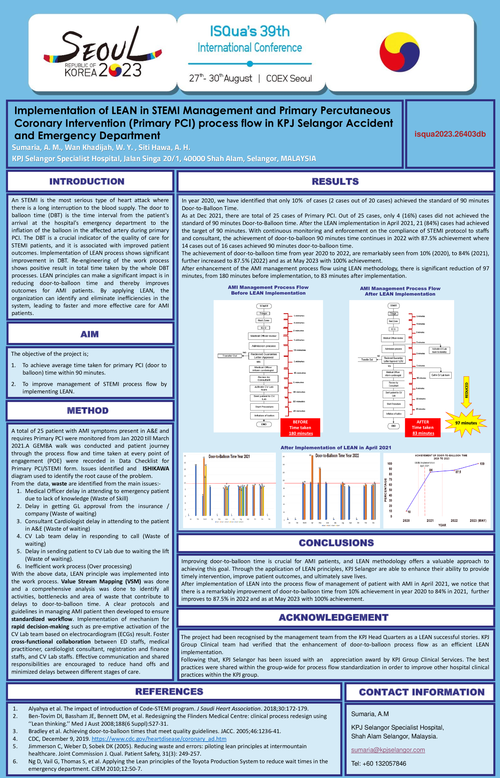
An STEMI is the most serious type of heart attack where there is a long interruption to the blood supply. The door to balloon time (DBT) is the time interval from the patient's arrival at the hospital's emergency department to the inflation of the balloon in the affected artery during primary PCI. The DBT is a crucial indicator of the quality of care for STEMI patients, and it is associated with improved patient outcomes. Implementation of LEAN process shows significant improvement in DBT. Re-engineering of the work process shows positive result in total time taken by the whole DBT processes. LEAN principles can make a significant impact is in reducing door-to-balloon time and thereby improves outcomes for AMI patients. By applying LEAN, the organization can identify and eliminate inefficiencies in the system, leading to faster and more effective care for AMI patients.
The objective of the project is;
Methodology
A total of 25 patient with AMI symptoms present in A&E and requires Primary PCI were monitored from Jan 2020 till March 2021.A GEMBA walk was conducted and patient journey through the process flow and time taken at every point of engagement (POE) were recorded in Data Checklist for Primary PCI/STEMI form. Issues identified and ISHIKAWA diagram used to identify the root cause of the problem.
From the data, waste are identified from the main issues:-
With the above data, LEAN principle was implemented into the work process. Value Stream Mapping (VSM) was done and a comprehensive analysis was done to identify all activities, bottlenecks and area of waste that contribute to delays to door-to-balloon time. A clear protocols and guidelines in managing AMI patient then developed to ensure standardized workflow. Implementation of mechanism for rapid decision-making such as pre-emptive activation of the CV Lab team based on electrocardiogram (ECGs) result. Foster cross-functional collaboration between ED staffs, medical practitioner, cardiologist consultant, registration and finance staffs, and CV Lab staffs. Effective communication and shared responsibilities are encouraged to reduce hand offs and minimized delays between different stages of care.
Results
In year 2020, we have identified that only 10% of cases (2 cases out of 20 cases) achieved the standard of 90 minutes Door-to-Balloon Time. As at Dec 2021, there are total of 25 cases of Primary PCI. Out of 25 cases, only 4 (16%) cases did not achieved the standard of 90 minutes Door-to-Balloon time. After the LEAN implementation in April 2021, 21 (84%) cases had achieved the target of 90 minutes. With continuous monitoring and enforcement on the compliance of STEMI protocol to staffs and consultant, the achievement of door-to-balloon 90 minutes time continues in 2022 with 87.5% achievement where 14 cases out of 16 cases achieved 90 minutes door-to-balloon time.
The achievement of door-to-balloon time from year 2020 to 2022, are remarkably seen from 10% (2020), to 84% (2021), further increased to 87.5% (2022) and as at May 2023 with 100% achievement.
After enhancement of the AMI management process flow using LEAN methodology, there is significant reduction of 97 minutes, from 180 minutes before implementation, to 83 minutes after implementation.
Conclusion
Improving door-to-balloon time is crucial for AMI patients, and LEAN methodology offers a valuable approach to achieving this goal. Through the application of LEAN principles, KPJ Selangor are able to enhance their ability to provide timely intervention, improve patient outcomes, and ultimately save lives.
After implementation of LEAN into the process flow of management of patient with AMI in April 2021, we notice that there is a remarkably improvement of door-to-balloon time from 10% achievement in year 2020 to 84% in 2021, further improves to 87.5% in 2022 and as at May 2023 with 100% achievement.
Acknowledgement
The project had been recognised by the management team from the KPJ Head Quarters as a LEAN successful stories. KPJ Group Clinical team had verified that the enhancement of door-to-balloon process flow as an efficient LEAN implementation.
Following that, KPJ Selangor has been issued with an appreciation award by KPJ Group Clinical Services. The best practices were shared within the group-wide for process flow standardization in order to improve other hospital clinical practices within the KPJ group.
References