708 posters, 8 topics, 16 sessions, 1,190 authors, 600 institutions
ePostersLive by SciGen Technologies S.A. All rights reserved.
ISQua's 39th International Conference 2023
August 27 - 30, 2023 | Seoul, Republic of Korea

P755
ASSESSING THE QUALITY OF HEMODIALYSIS HEALTHCARE SERVICE IN SOUTH KOREA
Poster Presenter
Authors
Affiliations
Part of Topic
Patient Safety & Quality Improvement
INTRODUCTION
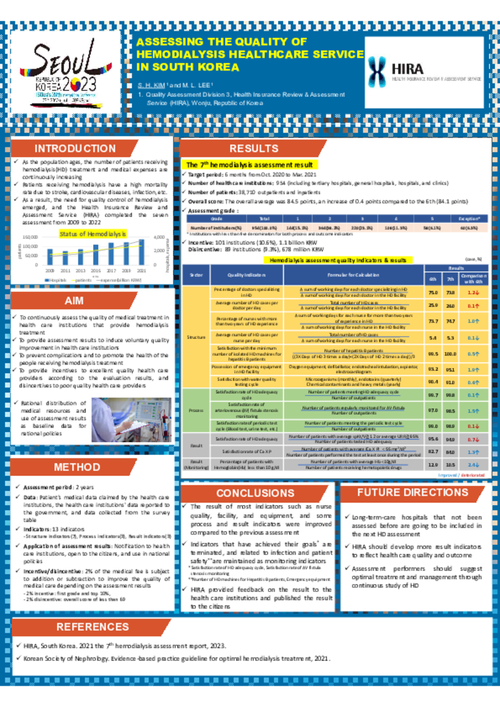
As the population ages, the number of patients receiving hemodialysis(HD) treatment and medical expenses are continuously increasing ü Patients receiving hemodialysis have a high mortality rate due to stroke, cardiovascular diseases, infection, etc. ü As a result, the need for quality control of hemodialysis emerged, and the Health Insurance Review and Assessment Service (HIRA) completed the seven assessment from 2009 to 2022
AIM
ü To continuously assess the quality of medical treatment in health care institutions that provide hemodialysis treatment ü To provide assessment results to induce voluntary quality improvement in health care institutions ü To prevent complications and to promote the health of the people receiving hemodialysis treatment ü To provide incentives to excellent quality health care providers according to the evaluation results, and disincentives to poor quality health care provider ü Rational distribution of medical resources and use of assessment results as baseline data for national policies
METHOD
ü Assessment period: 2 years ü Data: Patient's medical data claimed by the health care institutions, the health care institutions' data reported to the government, and data collected from the survey table ü Indicators: 13 indicators - Structure indicators(7), Process indicators(3), Result indicators(3) ü Application of assessment results: Notification to health care institutions, open to the citizens, and use in national policies ü Incentive/disincentive: 2% of the medical fee is subject to addition or subtraction to improve the quality of medical care depending on the assessment results - 2% incentive: first grade and top 10%, - 2% disincentive: overall score of less than 69
CONCLUSIONS
The result of most indicators such as nurse quality, facility, and equipment, and some process and result indicators were improved compared to the previous assessment ü Indicators that have achieved their goals* are terminated, and related to infection and patient safety**are maintained as monitoring indicators * Satisfaction rate of HD adequacy cycle, Satisfaction rate of AV fistula stenosis monitoring **Number of HD machines for Hepatitis B patients, Emergency equipment ü HIRA provided feedback on the result to the health care institutions and published the result to the citizens
FUTURE DIRECTIONS
Long-term-care hospitals that not been assessed before are going to be included in the next HD assessment ü HIRA should develop more result indicators to reflect health care quality and outcome ü Assessment performers should suggest optimal treatment and management through continuous study of HD