708 posters, 8 topics, 16 sessions, 1,190 authors, 600 institutions
ePostersLive by SciGen Technologies S.A. All rights reserved.
ISQua's 39th International Conference 2023
August 27 - 30, 2023 | Seoul, Republic of Korea

P748
INTEGRATION OF POWER BUSINESS INTELLIGENCE ONLINE MONITORING AND GUIDELINE-DIRECTED MEDICAL THERAPY TO IMPROVE THE CARE OF PATIENTS WITH HEART FAILURE : THE PARADIGM OF SGLT2I MEDICATION
Poster Presenter
Authors
Shu-Ling WANG, Hsiao-Fang Huang, Jih-Shuin Jerng, Jyh-Ming Juang
Affiliations
Department of Nursing, National Taiwan University Hospital, Department of Nursing, National Taiwan University Hospital, Student, Master Program, School of Nursing, National Taipei University of Nursing and Health Sciences, Taipei, Taiwan., Center for Quality Management, National Taiwan University Hospital, Taipei, Taiwan., Department of Internal Medicine, National Taiwan University Hospital, Taipei, Taiwan.
Part of Topic
Patient Safety & Quality Improvement
Integration of Power Business Intelligence Online Monitoring and Guideline-Directed Medical Therapy to Improve the Care of Patients With Heart Failure: The Paradigm of SGLT2i Medication
Shu-Ling Wang1,2, Hsiao-Fang Huang3*, Jih-Shuin Jerng 3,4, Jyh-Ming Juang4
1Department of Nursing, National Taiwan University Hospital, 2Student, Master Program, School of Nursing, National Taipei University of Nursing and Health Sciences, 3Center for Quality Management, 4Department of Internal Medicine, National Taiwan University Hospital, Taipei, Taiwan.
Keywords: guideline-directed medical therapy (GDMT), heart failure care, power bisiness intelligence (PBI).
Introduction:
The incidence and population of patients with heart failure have increased, thanks to the advances in medical sciences and improved survival of patients with coronary artery diseases. To promote guidelines and recommended care, monitoring of quality indicators for clinical heart failure care is a key process, but adding quality assurance tasks to the heart failure care team might be time-consuming and labor-intensive. Therefore, tools to automatically collect and analyze quality data might provide a better solution. We report our experience of integrating automated monitoring into guideline-based quality improvement in the clinical care of heart failure.
Methods:
The quality improvement core members of the heart failure care team of the consisting of cardiologists, nursing experts, quality and safety experts, and IT engineers, embarked on a program to implement Power Business Intelligence (PBI) (Microsoft® )-based monitoring of care quality in 2018. Core members were trained to understand and become familiar with the practice of the software, discussed and confirmed the definitions and methods for collecting the quality indicators based on the clinical care guidelines, and linked relevant data sources to accomplish automated data collection, calculation, and indicator analysis by displaying control charts and thresholds.
Results:
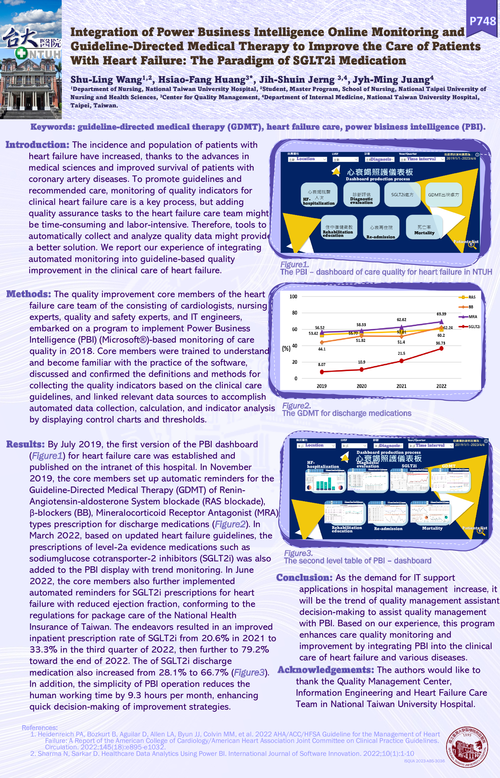
By July 2019, the first version of the PBI dashboard (Figure1) for heart failure care was established and published on the intranet of this hospital. In November 2019, the core members set up automatic reminders for the Guideline-Directed Medical Therapy (GDMT) of Renin-Angiotensin-aldosterone System blockade (RAS blockade), β-blockers (BB), Mineralocorticoid Receptor Antagonist (MRA) types prescription for discharge medications (Figure2). In March 2022, based on updated heart failure guidelines, the prescriptions of level-2a evidence medications such as sodiumglucose cotransporter-2 inhibitors (SGLT2i) was also added to the PBI display with trend monitoring. In June 2022, the core members also further implemented automated reminders for SGLT2i prescriptions for heart failure with reduced ejection fraction, conforming to the regulations for package care of the National Health Insurance of Taiwan. The endeavors resulted in an improved inpatient prescription rate of SGLT2i from 20.6% in 2021 to 33.3% in the third quarter of 2022, then further to 79.2% toward the end of 2022. The of SGLT2i discharge medication also increased from 28.1% to 66.7% (Figure3). In addition, the simplicity of PBI operation reduces the human working time by 9.3 hours per month, enhancing quick decision-making of improvement strategies.
Conclusion:
As the demand for IT support applications in hospital management increase, it will be the trend of quality management assistant decision-making to assist quality management with PBI. Based on our experience, this program enhances care quality monitoring and improvement by integrating PBI into the clinical care of heart failure and various diseases.
Acknowledgements:
The authors would like to thank the Quality Management Center, Information Engineering and Heart Failure Care Team in National Taiwan University Hospital.