708 posters, 8 topics, 16 sessions, 1,190 authors, 600 institutions
ePostersLive by SciGen Technologies S.A. All rights reserved.
ISQua's 39th International Conference 2023
August 27 - 30, 2023 | Seoul, Republic of Korea

P746
A STUDY ON THE DIFFERENCES IN TEAMWORK DIMENSIONS OF PATIENT SAFETY CULTURE IN MEDICAL QUALITY IMPROVEMENT TEAMS
Poster Presenter
Authors
Affiliations
Part of Topic
Patient Safety & Quality Improvement
A study on the differences in teamwork dimensions of patient safety culture in medical quality improvement teams
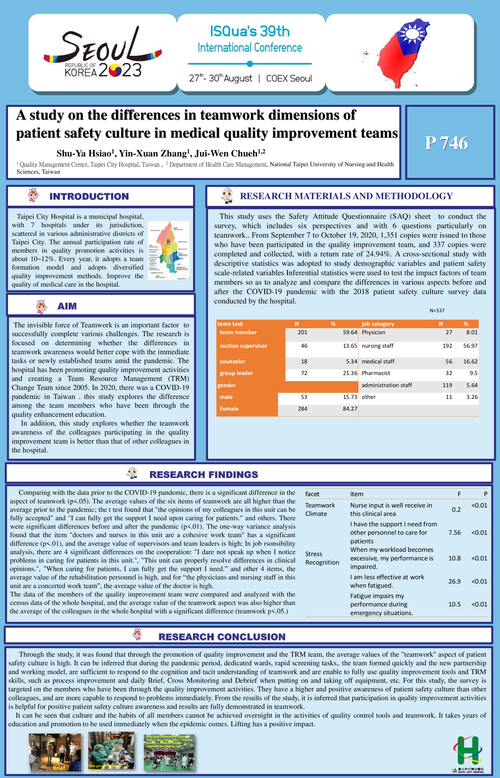
The invisible force of Teamwork is an important factor to successfully complete various challenges. The research is focused on determining whether the differences in teamwork awareness would better cope with the immediate tasks or newly established teams amid the pandemic. The hospital has been promoting quality improvement activities and creating a Team Resource Management (TRM) Change Team since 2005. In 2020, there was a COVID-19 pandemic in Taiwan . this study explores the difference among the team members who have been through the quality enhancement education.
In addition, this study explores whether the teamwork awareness of the colleagues participating in the quality improvement team is better than that of other colleagues in the hospital.
This study uses the Safety Attitude Questionnaire (SAQ) sheet to conduct the survey, which includes six perspectives and with 6 questions particularly on teamwork.. From September 7 to October 19, 2020, 1,351 copies were issued to those who have been participated in the quality improvement team, and 337 copies were completed and collected, with a return rate of 24.94%. A cross-sectional study with descriptive statistics was adopted to study demographic variables and patient safety scale-related variables Inferential statistics were used to test the impact factors of team members so as to analyze and compare the differences in various aspects before and after the COVID-19 pandemic with the 2018 patient safety culture survey data conducted by the hospital.
Comparing with the data prior to the COVID-19 pandemic, there is a significant difference in the aspect of teamwork (p<.05). The average values of the six items of teamwork are all higher than the average prior to the pandemic; the t test found that "the opinions of my colleagues in this unit can be fully accepted" and "I can fully get the support I need upon caring for patients." and others. There were significant differences before and after the pandemic (p<.01). The one-way variance analysis found that the item "doctors and nurses in this unit are a cohesive work team" has a significant difference (p<.01), and the average value of supervisors and team leaders is high; In job rsonsibility analysis, there are 4 significant differences on the cooperation: "I dare not speak up when I notice problems in caring for patients in this unit.", "This unit can properly resolve differences in clinical opinions.", "When caring for patients, I can fully get the support I need.” and other 4 items, the average value of the rehabilitation personnel is high, and for “the physicians and nursing staff in this unit are a concerted work team”, the average value of the doctor is high.
The data of the members of the quality improvement team were compared and analyzed with the census data of the whole hospital, and the average value of the teamwork aspect was also higher than the average of the colleagues in the whole hospital with a significant difference (teamwork p<.05.)
Through the study, it was found that through the promotion of quality improvement and the TRM team, the average values of the "teamwork" aspect of patient safety culture is high. It can be inferred that during the pandemic period, dedicated wards, rapid screening tasks,. the team formed quickly and the new partnership and working model, are sufficient to respond to the cognition and tacit understanding of teamwork and are enable to fully use quality improvement tools and TRM skills, such as process improvement and daily Brief, Cross Monitoring and Debrief when putting on and taking off equipment, etc. For this study, the survey is targeted on the members who have been through the quality improvement activities. They have a higher and positive awareness of patient safety culture than other colleagues, and are more capable to respond to problems immediately. From the results of the study, it is inferred that participation in quality improvement activities is helpful for positive patient safety culture awareness and results are fully demonstrated in teamwork.
It can be seen that culture and the habits of all members cannot be achieved overnight in the activities of quality control tools and teamwork. It takes years of education and promotion to be used immediately when the epidemic comes. Lifting has a positive impact.