708 posters, 8 topics, 16 sessions, 1,190 authors, 600 institutions
ePostersLive by SciGen Technologies S.A. All rights reserved.
ISQua's 39th International Conference 2023
August 27 - 30, 2023 | Seoul, Republic of Korea

P735
SOCIOECONOMIC FACTORS OF SERIOUSLY DISTRESSED PERSONS IN THE GENERAL POPULATION USING THE NATIONALLY REPRESENTATIVE DATA IN JAPAN
Poster Presenter
Authors
Affiliations
Part of Topic
Patient Safety & Quality Improvement
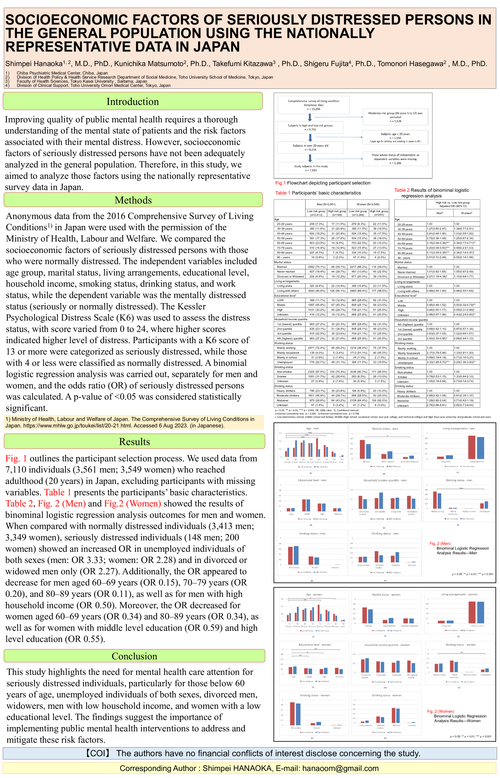
Introduction: Improving quality of public mental health requires a thorough understanding of the mental state of patients and the risk factors associated with their mental distress. However, socioeconomic factors of seriously distressed persons have not been adequately analyzed in the general population. Therefore, in this study, we aimed to analyze those factors using the nationally representative survey data in Japan.
Methods: Anonymous data from the 2016 Comprehensive Survey of Living Conditions1) in Japan were used with the permission of the Ministry of Health, Labour and Welfare. We compared the socioeconomic factors of seriously distressed persons with those who were normally distressed. The independent variables included age group, marital status, living arrangements, educational level, household income, smoking status, drinking status, and work status, while the dependent variable was the mentally distressed status (seriously or normally distressed). The Kessler Psychological Distress Scale (K6) was used to assess the distress status, with score varied from 0 to 24, where higher scores indicated higher level of distress. Participants with a K6 score of 13 or more were categorized as seriously distressed, while those with 4 or less were classified as normally distressed. A binomial logistic regression analysis was carried out, separately for men and women, and the odds ratio (OR) of seriously distressed persons was calculated. A p-value of <0.05 was considered statistically significant.
Results: Fig. 1 outlines the participant selection process. We used data from 7,110 individuals (3,561 men; 3,549 women) who reached adulthood (20 years) in Japan, excluding participants with missing variables. Table 1 presents the participants’ basic characteristics. Table 2, Fig. 2 (Men) and Fig.2 (Women) showed the results of binominal logistic regression analysis outcomes for men and women. When compared with normally distressed individuals (3,413 men; 3,349 women), seriously distressed individuals (148 men; 200 women) showed an increased OR in unemployed individuals of both sexes (men: OR 3.33; women: OR 2.28) and in divorced or widowed men only (OR 2.27). Additionally, the OR appeared to decrease for men aged 60–69 years (OR 0.15), 70–79 years (OR 0.20), and 80–89 years (OR 0.11), as well as for men with high household income (OR 0.50). Moreover, the OR decreased for women aged 60–69 years (OR 0.34) and 80–89 years (OR 0.34), as well as for women with middle level education (OR 0.59) and high level education (OR 0.55).
Conclusion: This study highlights the need for mental health care attention for seriously distressed individuals, particularly for those below 60 years of age, unemployed individuals of both sexes, divorced men, widowers, men with low household income, and women with a low educational level. The findings suggest the importance of implementing public mental health interventions to address and mitigate these risk factors.
References: 1) Ministry of Health, Labour and Welfare of Japan. The Comprehensive Survey of Living Conditions in Japan. https://www.mhlw.go.jp/toukei/list/20-21.html. Accessed 6 Aug 2023. (in Japanese).