708 posters, 8 topics, 16 sessions, 1,190 authors, 600 institutions
ePostersLive by SciGen Technologies S.A. All rights reserved.
ISQua's 39th International Conference 2023
August 27 - 30, 2023 | Seoul, Republic of Korea

P733
THE RISK FACTORS OF PT PROLONGATION AND THE EFFECTIVENESS OF PROPHYLACTIC VITAMIN K IN PATIENTS RECEIVING CEFOPERAZONE/SULBACTAM
Poster Presenter
Part of Topic
Patient Safety & Quality Improvement
Introduction: Cefoperazone-sulbactam, a third-generation cephalosporin/β-lactamase inhibitor combination, is extensively used to treat various infectious diseases in clinical practice. Prothrombin time (PT) prolongation and increased risk of bleeding have been both reported because the methylthiotetrazole side chain of cefoperazone would inhibit vitamin K 2, 3-epoxide reductase. However, it’s still controversial about the necessity for routine vitamin K prophylactic administration in general population. The aim of the study is to evaluate the risk factors of PT prolongation and the effectiveness of vitamin K for prophylaxis among patients receiving cefoperazone/sulbactam.
Methods: This study was conducted by using electronic medical records from a tertiary hospital in Southern Taiwan. Patients who have been treated with cefoperazone-sulbactam for at least 2 days during January 1, 2021 to December 31, 2021 were included and divided into two groups by receiving prophylactic vitamin K or not. To evaluate patient characteristics, we collected baseline data of age, sex, duration of antibiotic, underlying diseases, prior prescriptions and concomitant medications. PT (sec) and other coagulation index at baseline and after the last dose were all collected. The study endpoint were the mean PT change and the proportion of PT prolongation. Categorical and continuous variables were compared between two groups using χ2 tests and t tests, as appropriate. A logistic regression was performed to evaluate the risk factors of cefoperazone-sulbactam-related PT prolongation. P<0.05 was considered to indicate a statistically significant difference.
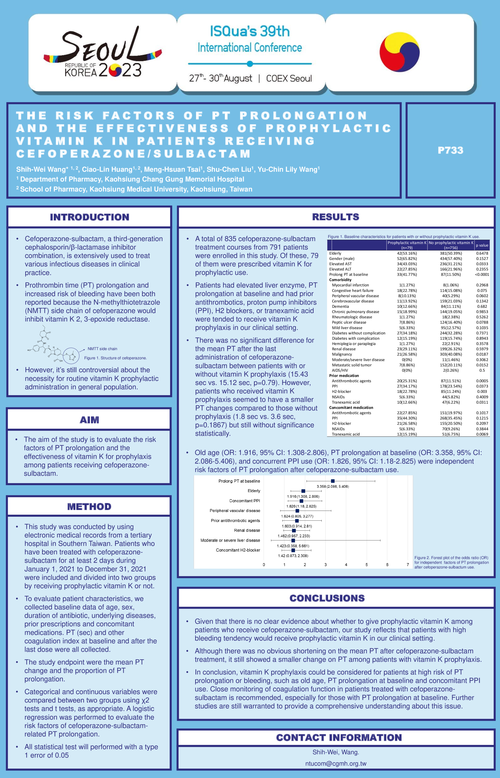
Results: A total of 835 cefoperazone-sulbactam treatment courses from 791 patients were enrolled in this study. Of these, 79 of them were prescribed vitamin K for prophylactic use. Patients had elevated liver enzyme, PT prolongation at baseline and had prior antithrombotics, proton pump inhibitors (PPI), H2 blockers, or tranexamic acid were tended to receive vitamin K prophylaxis in our clinical setting. There was no significant difference for the mean PT after the last administration of cefoperazone-sulbactam between patients with or without vitamin K prophylaxis (15.43 sec vs. 15.12 sec, p=0.79). However, patients who received vitamin K prophylaxis seemed to have a smaller PT changes compared to those without prophylaxis (1.8 sec vs. 3.6 sec, p=0.1867) but still without significance statistically. Old age (OR: 1.916, 95%CI: 1.308-2.806), PT prolongation at baseline (OR: 3.358, 95%CI: 2.086-5.406), and concurrent PPI use (OR: 1.826, 95%CI: 1.18-2.825) were independent risk factors of PT prolongation after cefoperazone-sulbactam use.
Conclusion: Given that there is no clear evidence about whether to give prophylactic vitamin K among patients who receive cefoperazone-sulbactam, our study reflects that patients with high bleeding tendency would receive prophylactic vitamin K in our clinical setting. Although there was no obvious shortening on the mean PT after cefoperazone-sulbactam treatment, it still showed a smaller change on PT among patients with vitamin K prophylaxis. In conclusion, vitamin K prophylaxis could be considered for patients at high risk of PT prolongation or bleeding, such as old age, PT prolongation at baseline and concomitant PPI use. Close monitoring of coagulation function in patients treated with cefoperazone-sulbactam is recommended, especially for those with PT prolongation at baseline. Further studies are still warranted to provide a comprehensive understanding about this issue.