708 posters, 8 topics, 16 sessions, 1,190 authors, 600 institutions
ePostersLive by SciGen Technologies S.A. All rights reserved.
ISQua's 39th International Conference 2023
August 27 - 30, 2023 | Seoul, Republic of Korea

P726
IMPROVING ADULT, INPATIENT DISCHARGE PROCESS TIME USING PDSA METHODOLOGY
Poster Presenter
Authors
Affiliations
Part of Topic
Patient Safety & Quality Improvement
IMPROVING ADULT, INPATIENT DISCHARGE PROCESS TIME USING PDSA METHODOLOGY
Sharifah Aisyah Shahabudin, Mah Kar Yee, Lim Siew Loon, Chan Chiew Kuan, Anida Elias, Farina Mohd Salleh
National Heart Institute,
Kuala Lumpur, Malaysia
Introduction:
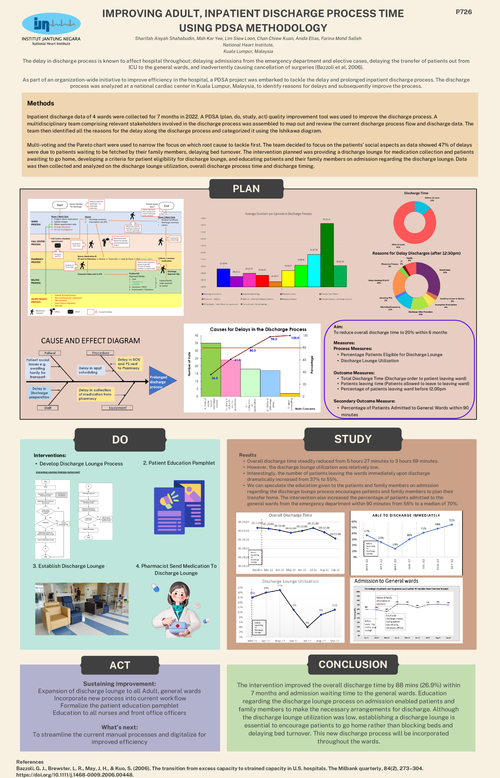
The delay in discharge process is known to affect hospital throughout; delaying admissions from the emergency department and elective cases, delaying the transfer of patients out from ICU to the general wards, and inadvertently causing cancellation of surgeries (Bazzoli et al, 2006). As part of an organization-wide initiative to improve efficiency in the hospital, a PDSA project was embarked to tackle the delay and prolonged inpatient discharge process. The discharge process was analyzed at a national cardiac center in Kuala Lumpur, Malaysia, to identify reasons for delays and subsequently improve the process.
Methods
Inpatient discharge data of 4 wards were collected for 7 months in 2022. A PDSA (plan, do, study, act) quality improvement tool was used to improve the discharge process. A multidisciplinary team comprising relevant stakeholders involved in the discharge process was assembled to map out and review the current discharge process flow and discharge data. The team then identified all the reasons for the delay along the discharge process and categorized it using the Ishikawa diagram.
Multi-voting and the Pareto chart were used to narrow the focus on which root cause to tackle first. The team decided to focus on the patients’ social aspects as data showed 47% of delays were due to patients waiting to be fetched by their family members, delaying bed turnover. The intervention planned was providing a discharge lounge for medication collection and patients awaiting to go home, developing a criteria for patient eligibility for discharge lounge, and educating patients and their family members on admission regarding the discharge lounge. Data was then collected and analyzed on the discharge lounge utilization, overall discharge process time and discharge timing.
Conclusion:
The intervention improved the overall discharge time by 88 mins (26.9%)within 7 months and admission waiting time to the general wards. Educationregarding the discharge lounge process on admission enabled patients andfamily members to make the necessary arrangements for discharge. Althoughthe discharge lounge utilization was low, establishing a discharge lounge isessential to encourage patients to go home rather than blocking beds anddelaying bed turnover. This new discharge process will be incorporatedthroughout the wards.