708 posters, 8 topics, 16 sessions, 1,190 authors, 600 institutions
ePostersLive by SciGen Technologies S.A. All rights reserved.
ISQua's 39th International Conference 2023
August 27 - 30, 2023 | Seoul, Republic of Korea

P711
GUIDED SELF-EVALUATION OF SAFETY STANDARDS FOR PERIOPERATIVE CARE IN 10 HOSPITALS ACROSS EUROPE: SAFEST PROJECT.
Poster Presenter
Authors
Rosa Sunol, Claudia Valli, Anna Rodriguez, Joaquim Baneres, Maria del Mar Fernandez, Pedro Casaca, Daniel Arnal, Hilly Calsbeek, Kaja Polluste, Adam Zaludek
Affiliations
AVEDIS DONABEDIAN RESEARCH INTITUTE, Department of Public Health, Charles University Third Faculty of Medicine, Prague, Czech Republic, Avedis Donabedian Research Institute, NOVA National School of Public Health. Comprehensive Health Research Center, Universidade NOVA de Lisboa, Lisbon, Portugal, Anaesthesia and Reanimation Unit. Fundación Alcorcon University Hospital, Alcorcon, Spain, Scientific Center for Quality of Healthcare (IQ healthcare), Radboud Institute for Health Sciences (RIHS), Radboud university medical center, Nijmegen, Netherlands, Department of Internal Medicine, Institute of Clinical Medicine, University of Tartu, Tartu, Estonia
Part of Topic
Patient Safety & Quality Improvement
GUIDED SELF-EVALUATION OF SAFETY STANDARDS FOR PERIOPERATIVE CARE IN 10 HOSPITALS ACROSS EUROPE: SAFEST PROJECT
Rosa Sunol* 1, 2, 3, Claudia Valli 1, 2, Anna Rodríguez 1, 2, Joaquim Bañeres 1, 2, 3, María del Mar Fernandez 1, 2, Pedro Casaca 4, Daniel Arnal 5, Hilly Calsbeek 6, Kaja Põlluste 7, Adam Zaludek 8
1 Avedis Donabedian Research Institute (FAD), 2 Universitat Autònoma de Barcelona, 3 Network for Research on Chronicity, Primary Care, and Health Promotion (RICAPPS), Barcelona, Spain, 4 NOVA National School of Public Health. Comprehensive Health Research Center, Universidade NOVA de Lisboa, Lisbon, Portugal, 5 Anaesthesia and Reanimation Unit. Fundación Alcorcon University Hospital, Alcorcon, Spain, 6 Scientific Center for Quality of Healthcare (IQ healthcare), Radboud Institute for Health Sciences (RIHS), Radboud university medical center, Nijmegen, Netherlands, 7 Department of Internal Medicine, Institute of Clinical Medicine, University of Tartu, Tartu, Estonia, 8 Department of Public Health, Charles University Third Faculty of Medicine, Prague, Czech Republic.
Introduction
Surgical care has been reported to have one of the highest prevalence of preventable patient harm. The adoption of evidence-based practices can significantly reduce adverse patient outcomes of surgical care. However, translating evidence into practice remains slow in healthcare; and sustainable effort should be made to overcome this challenge. One of the aims of the SAFEST project is to identify the best standards to improve patient safety during the entire perioperative period. This study aims to assess the degree of implementation of the SAFEST standards.
Methods
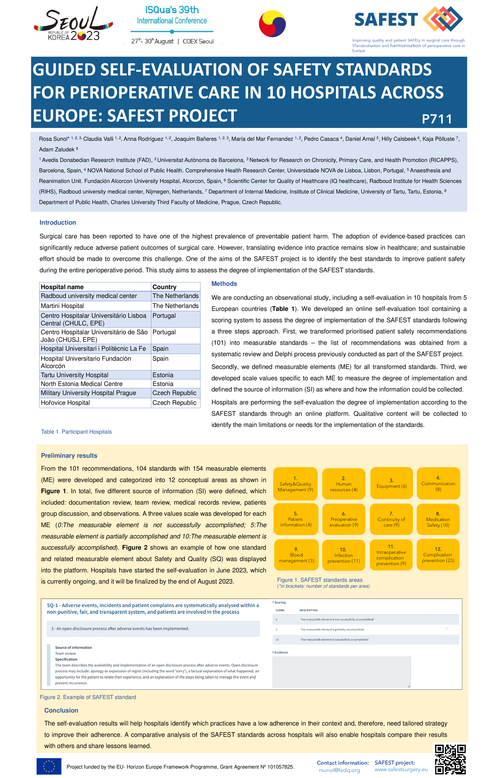
We are conducting an observational study, including a self-evaluation in 10 hospitals from 5 European countries (Table 1). We developed an online self-evaluation tool containing a scoring system to assess the degree of implementation of the SAFEST standards following a three steps approach. First, we transformed prioritised patient safety recommendations (101) into measurable standards – the list of recommendations was obtained from a systematic review and Delphi process previously conducted as part of the SAFEST project.
Secondly, we defined measurable elements (ME) for all transformed standards. Third, we developed scale values specific to each ME to measure the degree of implementation and defined the source of information (SI) as where and how the information could be collected.
Hospitals are performing the self-evaluation the degree of implementation according to the SAFEST standards through an online platform. Qualitative content will be collected to identify the main limitations or needs for the implementation of the standards.
Preliminary results
From the 101 recommendations, 104 standards with 154 measurable elements (ME) were developed and categorized into 12 conceptual areas as shown in Figure 1. In total, five different source of information (SI) were defined, which included: documentation review, team review, medical records review, patients group discussion, and observations. A three values scale was developed for each ME (0:The measurable element is not successfully accomplished; 5:The measurable element is partially accomplished and 10:The measurable element is successfully accomplished). Figure 2 shows an example of how one standard and related measurable element about Safety and Quality (SQ) was displayed into the platform. Hospitals have started the self-evaluation in June 2023, which is currently ongoing, and it will be finalized by the end of August 2023.
Conclusion
The self-evaluation results will help hospitals identify which practices have a low adherence in their context and, therefore, need tailored strategy to improve their adherence. A comparative analysis of the SAFEST standards across hospitals will also enable hospitals compare their results with others and share lessons learned.