708 posters, 8 topics, 16 sessions, 1,190 authors, 600 institutions
ePostersLive by SciGen Technologies S.A. All rights reserved.
ISQua's 39th International Conference 2023
August 27 - 30, 2023 | Seoul, Republic of Korea

P710
IDENTIFYING FACTORS THAT SUPPORT THE DELIVERY OF EXCEPTIONAL CARE IN GENERAL PRACTICE AND DEVELOPMENT OF THE IDEAL FRAMEWORK: A QUALITATIVE STUDY
Poster Presenter
Authors
Affiliations
Part of Topic
Patient Safety & Quality Improvement
Factors that Support the Delivery of Exceptional Care in General Practice: A Qualitative Study.
Backrgound: Efforts to improve care thus far have emphasised learning from instances of poor care (1). Recently, more proactive approaches have been advocated, that appreciate that patient care typically ‘goes well’, and occasionally, ‘exceedingly well’. The positive deviance approach seeks to identify and learn from individuals, teams or organisations that perform exceptionally well despite facing similar constraints as others within the community (2). Positive deviance has been gaining traction in general practice as a means to improve patient care, and results thus far have been promising (3). As the drive for high-quality primary-care based models of care increases, there is renewed impetus to study exceptional care delivery in general practice, to determine what factors are actually needed to deliver exceptional care in practice and how we can make these factors more commonplace.
Aim: This study aimed to identify and explore the key factors that support the delivery of exceptional care in general practice, along with the specific strategies, behaviours and processes used in practice to achieve the key factors identified., and to abstract these findings into the IDEAL framework for general practice.
Method: Design and sample 33 purposively sampled patients, general practitioners, practice nurses, and practice managers in Irish general practice. Data collection Semi-structured interviews were conducted. Participants were asked to discuss the factors that they have experienced to support the delivery of exceptional care across five system levels; patient, provider, team, practice, and macro, network and national level. Data analysis Data were analysed according to a directed content analysis approach (4). • Factors supporting exceptional care delivery were categorised deductively and inductively according to an existing framework of factors associated with positive deviance; the Identifying and Disseminating the Exceptional to Achieve Learning (IDEAL) framework (37 category framework). • In addition, specific strategies, behaviours and processes used to achieve the identified factors were inductively analysed and abstracted into the framework. As presented in Figure 1, this allowed for the refinement of previously developed Factors (i.e., predefined main categories of the IDEAL framework), and inductive development of Sub-factors (e.g., important aspects of the main factors) and Strategies (e.g., specific strategies, behaviours and processes used to achieve sub-factors).
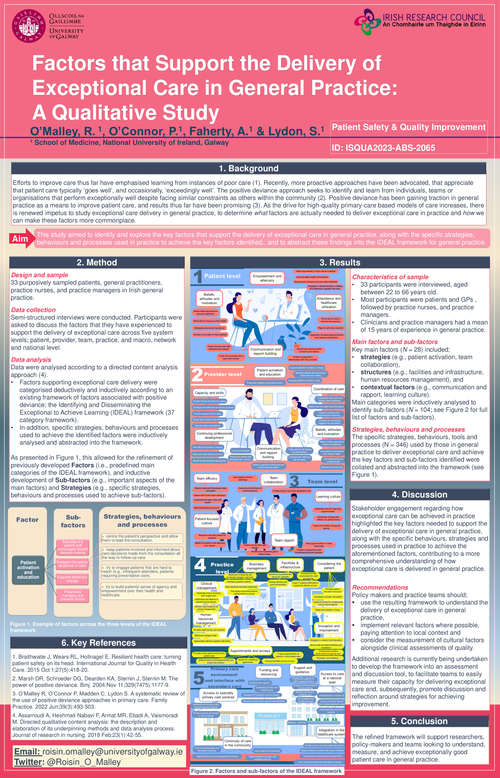
Results: Characteristics of sample • 33 participants were interviewed, aged between 22 to 66 years old. • Most participants were patients and GPs , followed by practice nurses, and practice managers. • Clinicians and practice managers had a mean of 15 years of experience in general practice. Main factors and sub-factors Key main factors (N = 28) included; • strategies (e.g., patient activation, team collaboration), • structures (e.g., facilities and infrastructure, human resources management), and • contextual factors (e.g., communication and rapport, learning culture). Main categories were inductively analysed to identify sub-factors (N = 104; see Figure 2 for full list of factors and sub-factors). Strategies, behaviours and processes The specific strategies, behaviours, tools and processes (N = 346) used by those in general practice to deliver exceptional care and achieve the key factors and sub-factors identified were collated and abstracted into the framework (see Figure 1).
Discussion: Stakeholder engagement regarding how exceptional care can be achieved in practice highlighted the key factors needed to support the delivery of exceptional care in general practice, along with the specific behaviours, strategies and processes used in practice to achieve the aforementioned factors, contributing to a more comprehensive understanding of how exceptional care is delivered in general practice. Recommendations Policy makers and practice teams should; use the resulting framework to understand the delivery of exceptional care in general practice, implement relevant factors where possible, paying attention to local context and consider the measurement of cultural factors alongside clinical assessments of quality. Additional research is currently being undertaken to develop the framework into an assessment and discussion tool, to facilitate teams to easily measure their capacity for delivering exceptional care and, subsequently, promote discussion and reflection around strategies for achieving improvement.
Conclusion: The refined framework will support researchers, policy-makers and teams looking to understand, measure, and achieve exceptionally good patient care in general practice.