708 posters, 8 topics, 16 sessions, 1,190 authors, 600 institutions
ePostersLive by SciGen Technologies S.A. All rights reserved.
ISQua's 39th International Conference 2023
August 27 - 30, 2023 | Seoul, Republic of Korea

P703
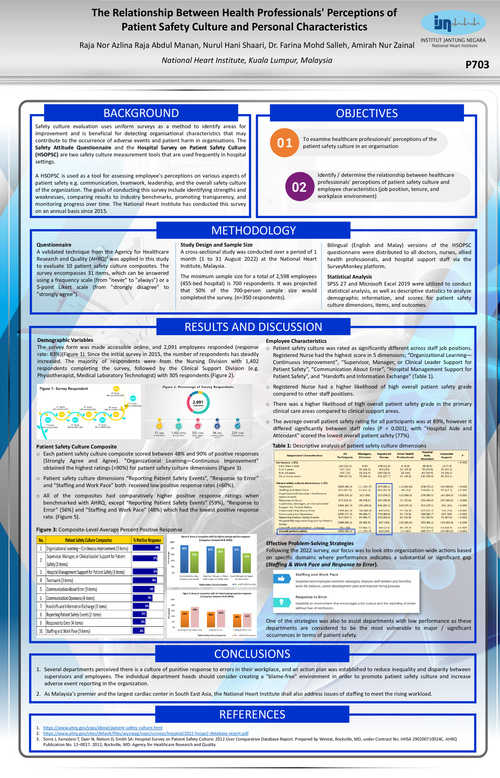
THE RELATIONSHIP BETWEEN HEALTH PROFESSIONALS' PERCEPTIONS OF PATIENT SAFETY CULTURE AND PERSONAL CHARACTERISTICS
Poster Presenter
Authors
Affiliations
Part of Topic
Patient Safety & Quality Improvement
The Relationship Between Health Professionals' Perceptions of Patient Safety Culture and Personal Characteristics
BACKGROUND
Safety culture evaluation uses uniform surveys as a method to identify areas for improvement and is beneficial for detecting organisational characteristics that may contribute to the occurrence of adverse events and patient harm in organisations. The Safety Attitude Questionnaire and the Hospital Survey on Patient Safety Culture (HSOPSC) are two safety culture measurement tools that are used frequently in hospital settings.
A HSOPSC is used as a tool for assessing employee's perceptions on various aspects of patient safety e.g. communication, teamwork, leadership, and the overall safety culture of the organization. The goals of conducting this survey include identifying strengths and weaknesses, comparing results to industry benchmarks, promoting transparency, and monitoring progress over time. The National Heart Institute has conducted this survey on an annual basis since 2015.
OBJECTIVES
1. To examine healthcare professionals' perceptions of the patient safety culture in an organisation
2. Identify / determine the relationship between healthcare professionals' perceptions of patient safety culture and employee characteristics (job position, tenure, and workplace environment)
METHODOLOGY
Questionnaire
A validated technique from the Agency for Healthcare Research and Quality (AHRQ)¹ was applied in this study to evaluate 10 patient safety culture composites. The survey encompasses 31 items, which can be answered using a frequency scale (from "never" to "always") or a 5-point Likert scale (from "strongly disagree" to "strongly agree").
Study Design and Sample Size
A cross-sectional study was conducted over a period of 1 month (1 to 31 August 2022) at the National Heart Institute, Malaysia.
The minimum sample size for a total of 2,598 employees (455-bed hospital) is 700 respondents. It was projected that 50% of the 700-person sample size would completed the survey. (n=350 respondents).
Bilingual (English and Malay) versions of the HSOPSC questionnaire were distributed to all doctors, nurses, allied health professionals, and hospital support staff via the SurveyMonkey platform.
Statistical Analysis
SPSS 27 and Microsoft Excel 2019 were utilized to conduct statistical analysis, as well as descriptive statistics to analyze demographic information, and scores for patient safety culture dimensions, items, and outcomes.
RESULTS AND DISCUSSION
Demographic Variables
The survey form was made accessible online, and 2,091 employees responded (response rate: 83%)(Figure 1). Since the initial survey in 2015, the number of respondents has steadily increased. The majority of respondents were from the Nursing Division with 1,402 respondents completing the survey, followed by the Clinical Support Division (e.g. Physiotherapist, Medical Laboratory Technologist) with 305 respondents (Figure 2).
Patient Safety Culture Composite
Employee Characteristics
4. The average overall patient safety rating for all participants was at 89%, however it differed significantly between staff roles (P < 0.001), with "Hospital Aide and Attendant" scored the lowest overall patient safety (77%).
Effective Problem-Solving Strategies
Following the 2022 survey, our focus was to look into organization-wide actions based on specific domains where performance indicates a substantial or significant gap (Staffing & Work Pace and Response to Error).
One of the strategies was also to assist departments with low performance as these departments are considered to be the most vulnerable to major / significant occurrences in terms of patient safety.
CONCLUSIONS