708 posters, 8 topics, 16 sessions, 1,190 authors, 600 institutions
ePostersLive by SciGen Technologies S.A. All rights reserved.
ISQua's 39th International Conference 2023
August 27 - 30, 2023 | Seoul, Republic of Korea

P684
EXERCISE PROGRAM TO IMPROVE FATIGUE, ANXIETY, AND DEPRESSION OF PEOPLE WITH GASTRIC CANCER: A RANDOMIZED CONTROLLED PILOT STUDY
Poster Presenter
Authors
Affiliations
Part of Topic
Patient Safety & Quality Improvement
EXERCISE PROGRAM TO IMPROVE FATIGUE, ANXIETY, AND DEPRESSION OF PEOPLE WITH GASTRIC CANCER: A RANDOMIZED CONTROLLED PILOT STUDY
Pei Shan Ho* 1
1nursing department, Taipei Veterans General Hospital, Taipei, Taiwan
Preferred presentation method: Poster Display
Are you a first time presenter at an ISQua Conference?: Yes
Introduction: Gastrectomy is the primary surgical treatment for gastric cancer. However, patients often experience a decrease in physical activity and emotional distress following surgery. Cancer patients often suffer from emotional distress but do not meet the clinical criteria for anxiety and depression. Exercise training for patients with cancer is recommended by the professional healthcare system. Exercise is seen as an adjunct treatment to improve fatigue, anxiety, and depression.
Methods: This study employed a parallel two-arm (1:1 ratio) from randomized controlled trials. In total, 28 patients were assigned to an experimental group (EG) or control group (CG). The exercise component participated in a 12-week walking program that comprised moderate-intensity walking for 40 min per session, with 3 sessions per week. The Brief Fatigue Inventory-Taiwan(BFI-T) and the hospital Anxiety and Depression Scale(HADS) were used to measure the level of the patient’s symptoms and were applied to measure symptoms at baseline and post-intervention.
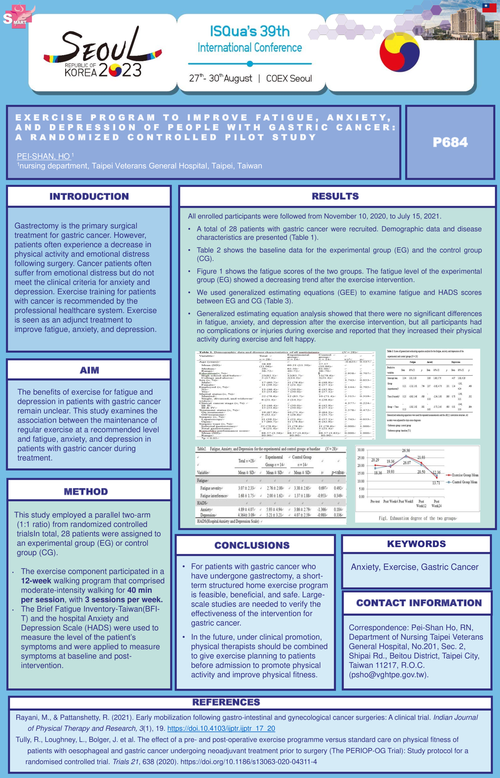
Results: All enrolled participants were followed from November 10, 2020, to July 15, 2021. A total of 28 patients with gastric cancer were recruited. Demographic data and disease characteristics are presented (Table 1). Table 2 shows the baseline data for the experimental group (EG) and the control group (CG). Figure 1 shows the fatigue scores of the two groups. The fatigue level of the experimental group (EG) showed a decreasing trend after the exercise intervention. We used generalized estimating equations (GEE) to examine fatigue and HADS scores between EG and CG (Table 3). Generalized estimating equation analysis showed that there were no significant differences in fatigue, anxiety, and depression after the exercise intervention, but all participants had no complications or injuries during exercise and reported that they increased their physical activity during exercise and felt happy.
Conclusion: For patients with gastric cancer who have undergone gastrectomy, a short-term structured home exercise program is feasible, beneficial, and safe. Large-scale studies are needed to verify the effectiveness of the intervention for gastric cancer. In the future, under clinical promotion, physical therapists should be combined to give exercise planning to patients before admission to promote physical activity and improve physical fitness.
Keywords: anxiety, Exercise, Gastric Cancer