708 posters, 8 topics, 16 sessions, 1,190 authors, 600 institutions
ePostersLive by SciGen Technologies S.A. All rights reserved.
ISQua's 39th International Conference 2023
August 27 - 30, 2023 | Seoul, Republic of Korea

P674
INCIDENCE AND CLINICAL IMPACT OF DELIRIUM AFTER TRANSCATHETER AORTIC VALVE IMPLANTATION IN JAPAN: AN INTERIM REPORT
Poster Presenter
Part of Topic
Patient Safety & Quality Improvement
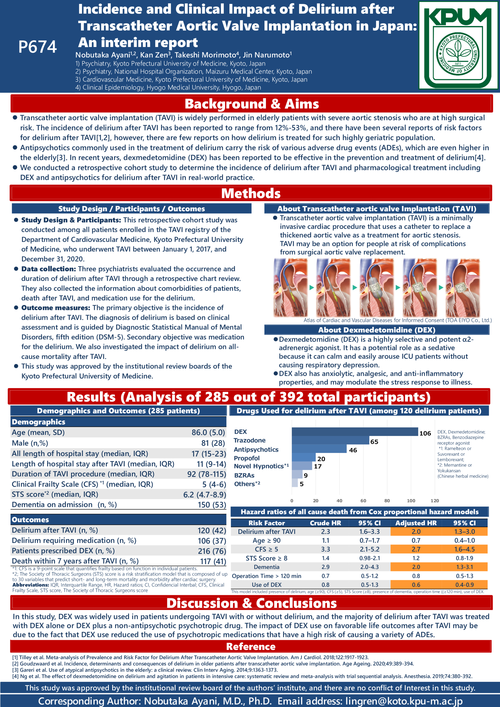
Incidence and Clinical Impact of Delirium after Transcatheter Aortic Valve Implantation in Japan: An interim report
Background&Aims
Methods
Study Design / Participants / Outcomes
About Transcatheter aortic valve Implantation (TAVI)
Transcatheter aortic valve implantation (TAVI) is a minimally invasive cardiac procedure that uses a catheter to replace a thickened aortic valve as a treatment for aortic stenosis.
TAVI may be an option for people at risk of complications from surgical aortic valve replacement.
[Atlas of Cardiac and Vascular Diseases for Informed Consent (TOA EIYO Co., Ltd.)]
About Dexmedetomidine (DEX)
Results (Analysis of 285 out of 392 total participants)
Patients Demographic and Outcome
Demographics and Outcomes (285 patients)
Outcomes
*1: CFS is a 9-point scale that quantifies frailty based on function in individual patients.
*2; The Society of Thoracic Surgeons (STS) score is a risk stratification model that is composed of up to 30 variables that predict short- and long-term mortality and morbidity after cardiac surgery.
Abbreviations: IQR, Interquartile Range, HR, Hazard ratios; CI, Confidencial Interbal; POD, Postoperative delirium; CFS, Clinical Frailty Scale, STS score, The Society of Thoracic Surgeons score
Drugs Used for POD patients (N=120)
Hazard ratios of all cause death from Cox proportional hazard models
This model included presence of POD, age (≥90), CFS (≥5), STS Score (≥8), presence of dementia, operation time ((≥120 min), use of DEX.
Discussion & Conclusions
In this study, DEX was widely used in patients undergoing TAVI with or without delirium, and the majority of delirium after TAVI was treated with DEX alone or DEX plus a non-antipsychotic psychotropic drug. The impact of DEX use on favorable life outcomes after TAVI may be due to the fact that DEX use reduced the use of psychotropic medications that have a high risk of causing a variety of ADEs.
Reference
[1] Tilley et al. Meta-analysis of Prevalence and Risk Factor for Delirium After Transcatheter Aortic Valve Implantation. Am J Cardiol. 2018;122:1917-1923.
[2] Goudzwaard et al. Incidence, determinants and consequences of delirium in older patients after transcatheter aortic valve implantation. Age Ageing. 2020;49:389-394.
[3] Gareri et al. Use of atypical antipsychotics in the elderly: a clinical review. Clin Interv Aging. 2014;9:1363-1373.
[4] Ng et al. The effect of dexmedetomidine on delirium and agitation in patients in intensive care: systematic review and meta-analysis with trial sequential analysis. Anesthesia. 2019;74:380-392.
This study was approved by the institutional review board of the authors’ institute, and there are no conflict of Interest in this study.
Corresponding Author: Nobutaka Ayani, M.D., Ph.D. Email address: lingren@koto.kpu-m.ac.jp