708 posters, 8 topics, 16 sessions, 1,190 authors, 600 institutions
ePostersLive by SciGen Technologies S.A. All rights reserved.
ISQua's 39th International Conference 2023
August 27 - 30, 2023 | Seoul, Republic of Korea

P673
KEEPING PATIENTS SAFE DURING SURGERY: AN INTERVENTIONAL STUDY TO ENHANCE COMPLIANCE TO THE SURGICAL SAFETY CHECKLIST AT A TERTIARY CARE TEACHING HOSPITAL IN INDIA
Poster Presenter
Authors
Affiliations
Part of Topic
Patient Safety & Quality Improvement
Keeping Patients Safe During Surgery: An Interventional Study to Enhance Compliance to the Surgical Safety Checklist at a Tertiary Care Teaching Hospital in India
Nishant Sharma1, Kanika Jain1, Vijaydeep Siddharth1, Anant Gupta1, Tilotma Jamwal1
1 Department of Hospital Administration, AIIMS, New Delhi
INTRODUCTION
AIM:
To improve the compliance to the Surgical Safety Checklist through multi-pronged intervention at a Tertiary Care Teaching Hospital in India.
OBJECTIVES:
METHODS:
Study setting: Twelve Operating Rooms of a tertiary care teaching hospital.
The baseline data was collected from the medical records of all patients who underwent surgical procedures over one month.
A focused group discussion was held with the stakeholders to identify the root cause of poor compliance.
Based on this, a multi-pronged approach was adopted to sensitize the operating teams of four departments (study group) regarding the SSC; the other three departments constituted the control group.
Post-intervention, the compliance was again measured across all seven departments, and the results were statistically analyzed.
RESULTS:
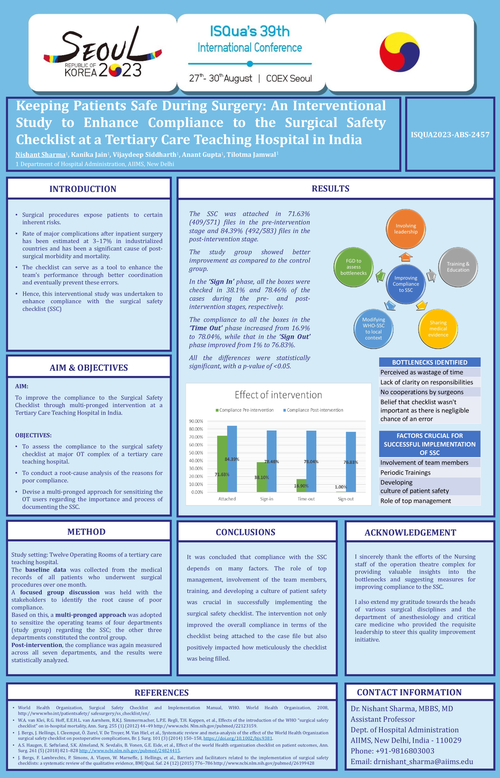
The SSC was attached in 71.63% (409/571) files in the pre-intervention stage and 84.39% (492/583) files in the post-intervention stage.
The study group showed better improvement as compared to the control group.
In the ‘Sign In’ phase, all the boxes were checked in 38.1% and 78.46% of the cases during the pre- and post-intervention stages, respectively.
The compliance to all the boxes in the ‘Time Out’ phase increased from 16.9% to 78.04%, while that in the ‘Sign Out’ phase improved from 1% to 76.83%.
All the differences were statistically significant, with a p-value of <0.05.
CONCLUSION:
It was concluded that compliance with the SSC depends on many factors. The role of top management, involvement of the team members, training, and developing a culture of patient safety was crucial in successfully implementing the surgical safety checklist. The intervention not only improved the overall compliance in terms of the checklist being attached to the case file but also positively impacted how meticulously the checklist was being filled.