708 posters, 8 topics, 16 sessions, 1,190 authors, 600 institutions
ePostersLive by SciGen Technologies S.A. All rights reserved.
ISQua's 39th International Conference 2023
August 27 - 30, 2023 | Seoul, Republic of Korea

P670
BARRIERS TO INPATIENT ONCOLOGY ADMISSIONS IN THE ABSENCE OF AN EMERGENCY DEPARTMENT
Poster Presenter
Authors
Niamh M CROWLEY, Timothy D Clay, Andrew Dean, Nisha Sikotra, Susanna Murphy, Hazel Everett, Eli Gabbay, Ethan Hawke
Affiliations
Part of Topic
Patient Safety & Quality Improvement
Barriers to Inpatient Oncology Admissions in the Absence of an Emergency Department
Introduction
St John of God Subiaco Hospital (SJOGSH) is a tertiary hospital situated in Perth, Western Australia. The hospital has a significant haematology/oncology service but does not have an emergency department (ED). The service uses a nursing-lead telephone triage system to support patients with complications of their condition or therapy through which admissions to the Acute Admission Unit (AAU) may occur. Prior to the triage service patients were being admitted via multiple routes, including consultant rooms and on discussion with administration staff. There was an anecdotal view amongst consultants that this lack of patient assessment prior to presentation to the hospital resulted in patients often arriving very unwell, requiring activation of the medical emergency response (MER) team. Multiple routes of entering the hospital also made it difficult to keep a record of oncology patient admissions and monitor areas that require improvement. The triage phone service allowed a central area with readily available patient data, facilitating interrogation of this data to allow us to better understand barriers to admission and via this pathway to create a more streamlined process and enable less fragmentation of care by expanding our AAU.
Methods
This was a retrospective review of the triage call logs over a 3-month time period from September 1st 2022 to November 30th 2022
Results
Over the study period 142 calls were made to the triage service. Of these calls;
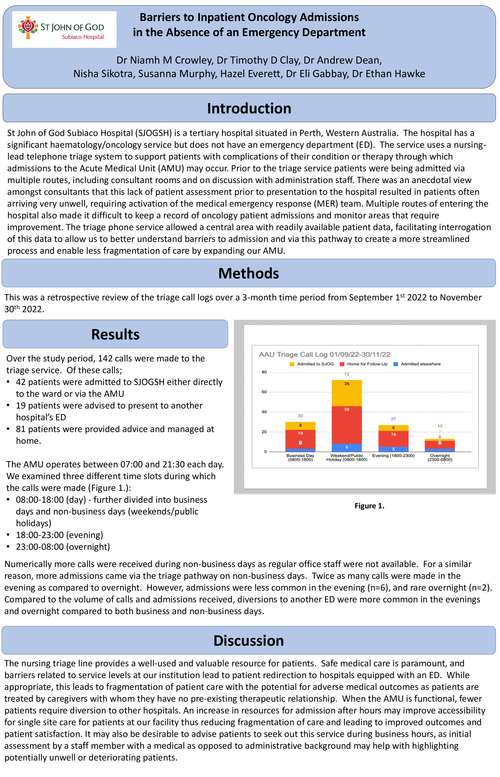
The AAU operates between 0700 and 2130 each day. We examined three different time slots during which the calls were made (Figure 1.);
Numerically more calls were received during non-business days as regular office staff were not available. For a similar reason, more admissions came via the triage pathway on non-business days. Twice as many calls were made in the evening as compared to overnight. However, admissions were less common in the evening (n=6), and rare overnight (n=2). Compared to the volume of calls and admissions received, diversions to another ED were more common in the evenings and overnight compared to both business and non-business days.
Discussion
The nursing triage line provides a well-used and valuable resource for patients. Safe medical care is paramount and as such barriers related to service levels at our institution lead to patient redirection to hospitals equipped with an ED. While appropriate, this leads to fragmentation of patient care with the potential for adverse medical outcomes as patients are treated by caregivers with whom they have no pre-existing therapeutic relationship. When the AAU is functional fewer patients require diversion to other hospitals. An increase in resources for admission after hours may improve accessibility for single site care for patients at our facility thus reducing fragmentation of care and leading to improved outcomes and patient satisfaction. It may also be desirable to advise patients to seek out this service during business hours, as initial assessment by a staff member with a medical as opposed to administrative background may help with highlighting potentially unwell or deteriorating patients.