708 posters, 8 topics, 16 sessions, 1,190 authors, 600 institutions
ePostersLive by SciGen Technologies S.A. All rights reserved.
ISQua's 39th International Conference 2023
August 27 - 30, 2023 | Seoul, Republic of Korea

ISQUA2023-ABS-2710
PERCEPTIONS AND ATTITUDES OF HEALTH PROFESSIONALS TO USE AUGMENTED REALITY TECHNOLOGIES IN TRAINING
Poster Presenter
Authors
Affiliations
Part of Topic
Patient Safety & Quality Improvement
PERCEPTIONS AND ATTITUDES OF HEALTH PROFESSIONALS TO USE AUGMENTED REALITY TECHNOLOGIES IN TRAINING
Elif ÖZYURT1, Didem İNCEGİL2, İbrahim H. KAYRAL3
Abstracts
Introduction: The importance of innovative technologies in improving and developing the education, service delivery and care processes of health professionals, which are the basic building blocks of health services, is increasing day by day. Augmented Reality (AR) technology increases the effectiveness and efficiency of learning processes by making learning attractive, increasing its permanence, embodying abstract concepts, facilitating the learning of dangerous and difficult-to-observe applications, and providing many practical opportunities. With this research, it is aimed to determine the perceptions and attitudes of healthcare professionals regarding the use of AR technologies in applied education processes during the COVID-19 pandemic period and to contribute to a quality healthcare service in line with the recommendations to be made.
Method: The study was carried out with 182 health workers (physicians and nurses) working in a public hospital. The "Technology Acceptance Model (TKM) Questionnaire" developed by Kaenchan, P. (2018) was used to measure the perceptions and attitudes of healthcare professionals about using AR Technologies. The analysis of the data was made using the IBM SPSS 25.0 statistical package program.
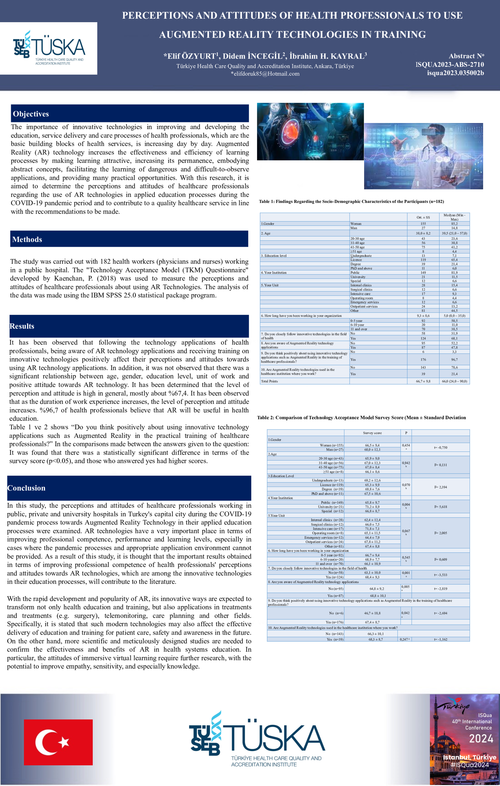
Results: It has been observed that following the technology applications of health professionals, being aware of AR technology applications and receiving training on innovative technologies positively affect their perceptions and attitudes towards using AR technology applications. In addition, it was not observed that there was a significant relationship between age, gender, education level, unit of work and positive attitude towards AR technology. It has been determined that the level of perception and attitude is high in general, mostly about %67,4. It has been observed that as the duration of work experience increases, the level of perception and attitude increases. %96,7 of health professionals believe that AR will be useful in health education.
Table 1 ve 2 shows “Do you think positively about using innovative technology applications such as Augmented Reality in the practical training of healthcare professionals?” In the comparisons made between the answers given to the question: It was found that there was a statistically significant difference in terms of the survey score (p<0.05), and those who answered yes had higher scores.
Conclusions: In this study, the perceptions and attitudes of healthcare professionals working in public, private and university hospitals in Turkey's capital city during the COVID-19 pandemic process towards Augmented Reality Technology in their applied education processes were examined. AR technologies have a very important place in terms of improving professional competence, performance and learning levels, especially in cases where the pandemic processes and appropriate application environment cannot be provided. As a result of this study, it is thought that the important results obtained in terms of improving professional competence of health professionals' perceptions and attitudes towards AR technologies, which are among the innovative technologies in their education processes, will contribute to the literature.
With the rapid development and popularity of AR, its innovative ways are expected to transform not only health education and training, but also applications in treatments and treatments (e.g. surgery), telemonitoring, care planning and other fields. Specifically, it is stated that such modern technologies may also affect the effective delivery of education and training for patient care, safety and awareness in the future. On the other hand, more scientific and meticulously designed studies are needed to confirm the effectiveness and benefits of AR in health systems education. In particular, the attitudes of immersive virtual learning require further research, with the potential to improve empathy, sensitivity, and especially knowledge.
Keywords: Augmented Reality, Health professionals, Education, Patient Safety, Quality