708 posters, 8 topics, 16 sessions, 1,190 authors, 600 institutions
ePostersLive by SciGen Technologies S.A. All rights reserved.
ISQua's 39th International Conference 2023
August 27 - 30, 2023 | Seoul, Republic of Korea

P667
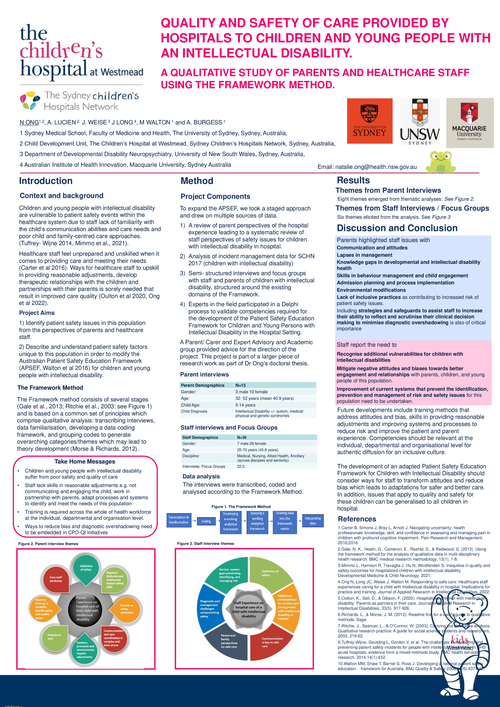
QUALITY AND SAFETY OF CARE PROVIDED BY HOSPITALS TO CHILDREN AND YOUNG PEOPLE WITH AN INTELLECTUAL DISABILITY. A QUALITATIVE STUDY OF PARENTS AND HEALTHCARE STAFF USING THE FRAMEWORK METHOD.
Poster Presenter
Authors
Affiliations
Part of Topic
Patient Safety & Quality Improvement
QUALITY AND SAFETY OF CARE PROVIDED BY HOSPITALS TO CHILDREN AND YOUNG PEOPLE WITH AN INTELLECTUAL DISABILITY.
A QUALITATIVE STUDY OF PARENTS AND HEALTHCARE STAFF USING THE FRAMEWORK METHOD.
N ONG1,2, A. LUCIEN 2 J. WEISE 3 J LONG 4, M WALTON 1 and A. BURGESS 1
1 Sydney Medical School, Faculty of Medicine and Health, The University of Sydney, Sydney, Australia,
2 Child Development Unit, The Children’s Hospital at Westmead, Sydney Children’s Hospitals Network, Sydney, Australia,
3 Department of Developmental Disability Neuropsychiatry, University of New South Wales, Sydney, Australia,
4 Australian Institute of Health Innovation, Macquarie University, Sydney Australia
Context and Background
Children and young people with intellectual disability are vulnerable to patient safety events within the healthcare system due to staff lack of familiarity with the child’s communication abilities and care needs and poor child and family-centred care approaches. (Tuffrey- Wijne 2014, Mimmo et al., 2021).
Healthcare staff feel unprepared and unskilled when it comes to providing care and meeting their needs (Carter et al 2016). Ways for healthcare staff to upskill in providing reasonable adjustments, develop therapeutic relationships with the children and partnerships with their parents is sorely needed that result in improved care quality (Oulton et al 2020, Ong et al 2022).
Project Aims:
1) Identify patient safety issues in this population from the perspectives of parents and healthcare staff.
2) Describe and understand patient safety factors unique to this population in order to modify the Australian Patient Safety Education Framework (APSEF, Walton et al 2016) for children and young people with intellectual disability.
The Framework Method
The Framework method consists of several stages (Gale et al., 2013; Ritchie et al., 2003; see Figure 1) and is based on a common set of principles which comprise qualitative analysis: transcribing interviews, data familiarisation, developing a data coding framework, and grouping codes to generate overarching categories/themes which may lead to theory development (Morse & Richards, 2012).
Method
Project Components
To expand the APSEF, we took a staged approach and drew on multiple sources of data.
A Parent/ Carer and Expert Advisory and Academic group provided advice for the direction of the project. This project is part of a larger piece of research work as part of Dr Ong’s doctoral thesis.
Discussion and Conclusion
Parents highlighted staff issues with
Communication and attitudes
Lapses in management
Knowledge gaps in developmental and intellectual disability health
Skills in behaviour management and child engagement
Admission planning and process implementation
Environmental modifications
Lack of inclusive practices as contributing to increased risk of patient safety issues.
Including strategies and safeguards to assist staff to increase their ability to reflect and scrutinise their clinical decision making to minimise diagnostic overshadowing is also of critical importance
Staff report the need to
Recognise additional vulnerabilities for children with intellectual disabilities
Mitigate negative attitudes and biases towards better engagement and relationships with parents, children, and young people of this population.
Improvement of current systems that prevent the identification, prevention and management of risk and safety issues for this population need to be undertaken.
Future developments include training methods that address attitudes and bias, skills in providing reasonable adjustments and improving systems and processes to reduce risk and improve the patient and parent experience. Competencies should be relevant at the individual, departmental and organisational level for authentic diffusion for an inclusive culture.
The development of an adapted Patient Safety Education Framework for Children with Intellectual Disability should consider ways for staff to transform attitudes and reduce bias which leads to adaptations for safer and better care. In addition, issues that apply to quality and safety for these children can be generalised to all children in hospital.
Take Home Messages
Children and young people with intellectual disability suffer from poor safety and quality of care
Staff lack skills in reasonable adjustments e.g. not communicating and engaging the child, work in partnership with parents, adapt processes and systems to identify and meet the needs of this population
Training is required across the whole of health workforce at the individual, departmental and organisation level.
Ways to reduce bias and diagnostic overshadowing need to be embedded in CPD-QI initiatives