708 posters, 8 topics, 16 sessions, 1,190 authors, 600 institutions
ePostersLive by SciGen Technologies S.A. All rights reserved.
ISQua's 39th International Conference 2023
August 27 - 30, 2023 | Seoul, Republic of Korea

P666
APPILCATION OF PERCUTANEOUS CRYOABLATION THERAPY TO IMPROVE THE QUALITY OF POST-OPERATION CARE IN PATIENTS WITH RENAL TUMORS
Poster Presenter
Authors
Affiliations
Part of Topic
Patient Safety & Quality Improvement
Appilcation of Percutaneous Cryoablation Therapy to Improve the Quality of Post-operation Care in Patients with Renal Tumors
Nan-Han Lu1, Kuo-Ying Liu1, Hung-Yu Lin2, Lien-En Huang3
Department of Radiology1, Surgery2, Quality Management3, E-DA Cancer Hospital/I-Shou University
Introduction
Surgical treatment is the first choice with partial nephrectomy for early renal tumors. The use of partial nephrectomy still need to consider the post-operation care problems. In recent years, the minimal invasion treatments have developed such as laparoscopic surgery, radiofrequency ablation and cryoablation therapy. There are advantages and disadvantages in these treatments.
Aim
The purpose of this project is to apply the percutaneous cryoablation therapy in patients with renal tumors and to improve the quality of post-operation care.
Method
Team resource management(TRM) is the use of clinical teamwork including radiology, anaethesia department and surgical staff. The medical team pay attention to leadership, monitoring, mutual assistance and communication. We performed the cryoablation procedures in the operation room(OR) with real-time computed tomogram(CT) guiding. All patients under general anaesthesia were placed in prone or oblique prone position. First step, we did the biopsy of the renal tumor. Second step, we inserted the cryoablation needles into the tumor in appropriate location. Third step, three cycles of cryoablation therapy were performed. Finally, we evaluated the post treatment condition using real-time CT images. Quality of post-operation care, indicators included the pain score, morbidity and length of hospitalization.
Result
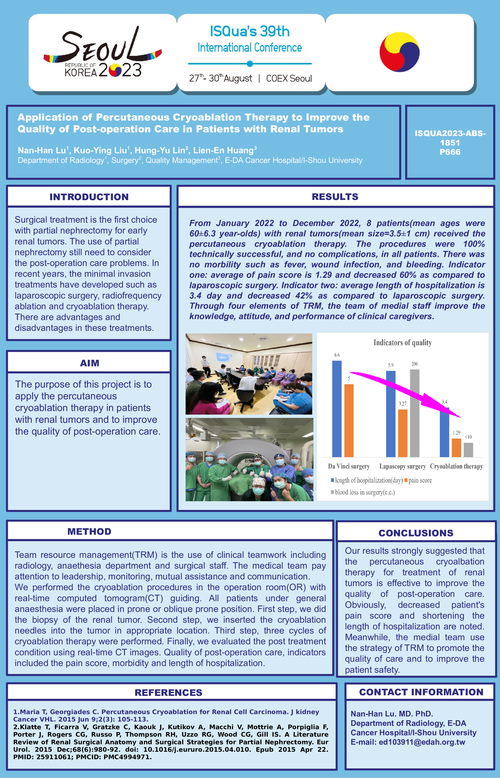
From January 2022 to December 2022, 8 patients(mean ages were 60±6.3 year-olds)with renal tumors(mean size=3.5±1 cm) received the percutaneous cryoablation therapy. The procedures were 100% technically successful, and no complications, in all patients. There was no morbility such as fever, wound infection, and bleeding. Indicator one: average of pain score is 1.29 and decreased 60% as compared to laparoscopic surgery. Indicator two: average length of hospitalization is 3.4 day and decreased 42% as compared to laparoscopic surgery. Through four elements of TRM, the team of medial staff improve the knowledge, attitude, and performance of clinical caregivers.
Conclusions
Our results strongly suggested that the percutaneous cryoalbation therapy for treatment of renal tumors is effective to improve the quality of post-operation care. Obviously, decreased patient's pain score and shortening the length of hospitalization are noted. Meanwhile, the medial team use the strategy of TRM to promote the quality of care and to improve the patient safty.
References
Maria T, Georgiades C. Percutaneous Cryoablation for Renal Cell Carcinoma. J kidney Cancer VHL. 2015 Jun 9;2(3): 105-113.